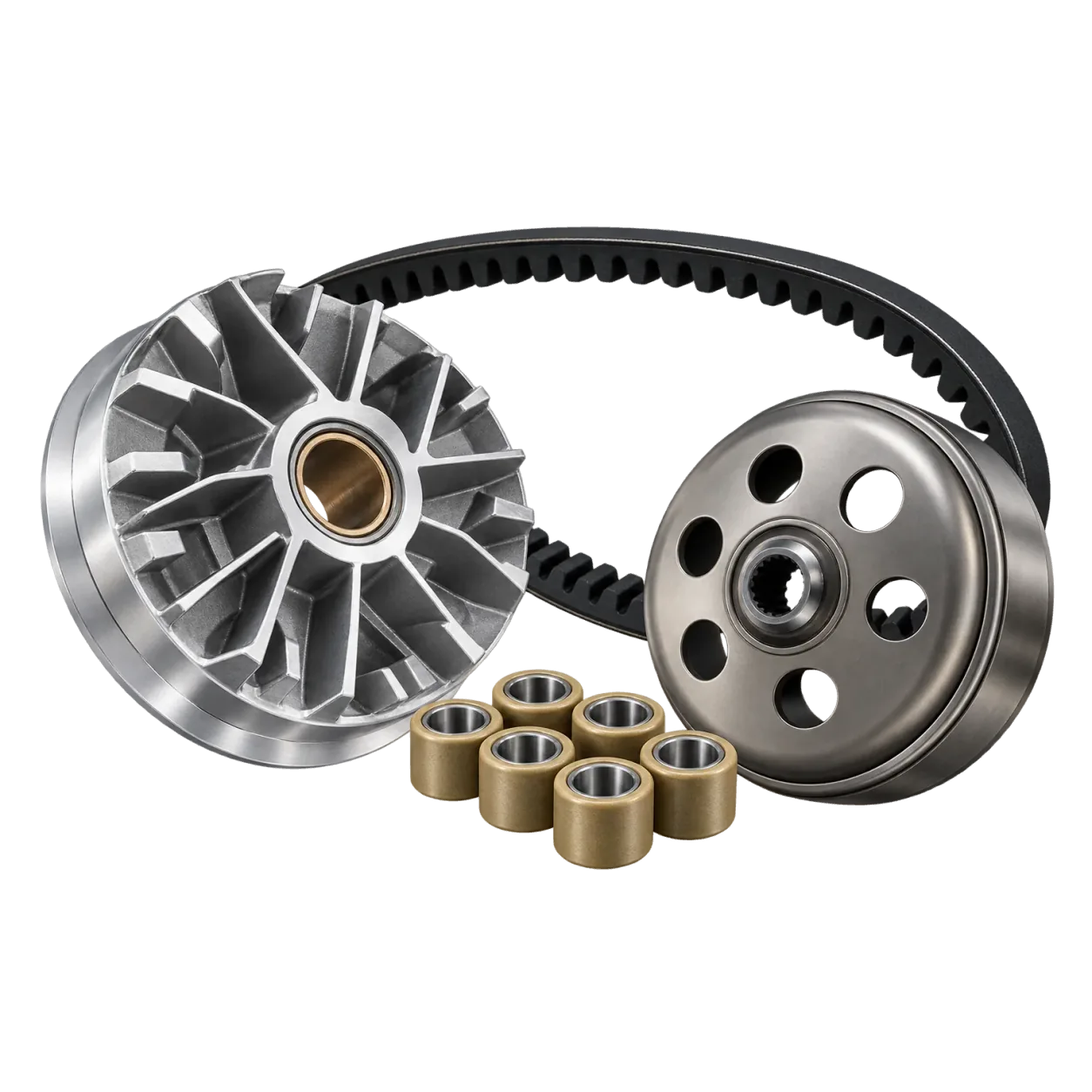
motorcycle, scooter and small-displacement parts / Buying guide
Workshop belts, rollers and filters: local or combined import?
Last updated
Published by 1688 Moto Parts · Review method
Key takeaways
- Stock by verified application and service unit, keeping complete roller sets separate from individual-piece prices.
- The illustrative dry basket totals USD 280 locally, USD 305 as a combined import and USD 347 as separate imports.
- No demand, price or freight is verified in the scenario; replace assumptions and evaluate restricted items separately.
Buy workshop consumables by confirmed application and expected jobs, then compare the complete cash outlay. A combined import can suit repeat demand, but belts and rollers that fit the wrong variant are not useful inventory.
The example is illustrative arithmetic prepared on 2 October 2026, with invented prices and transport allowances. It describes no customer order, supplier offer, tested part, shipment or verified saving.
Turn this guide into a buying request
Keep this page as context. Add what you know; review everything before sending. No purchase is made at this step.
Continue to request →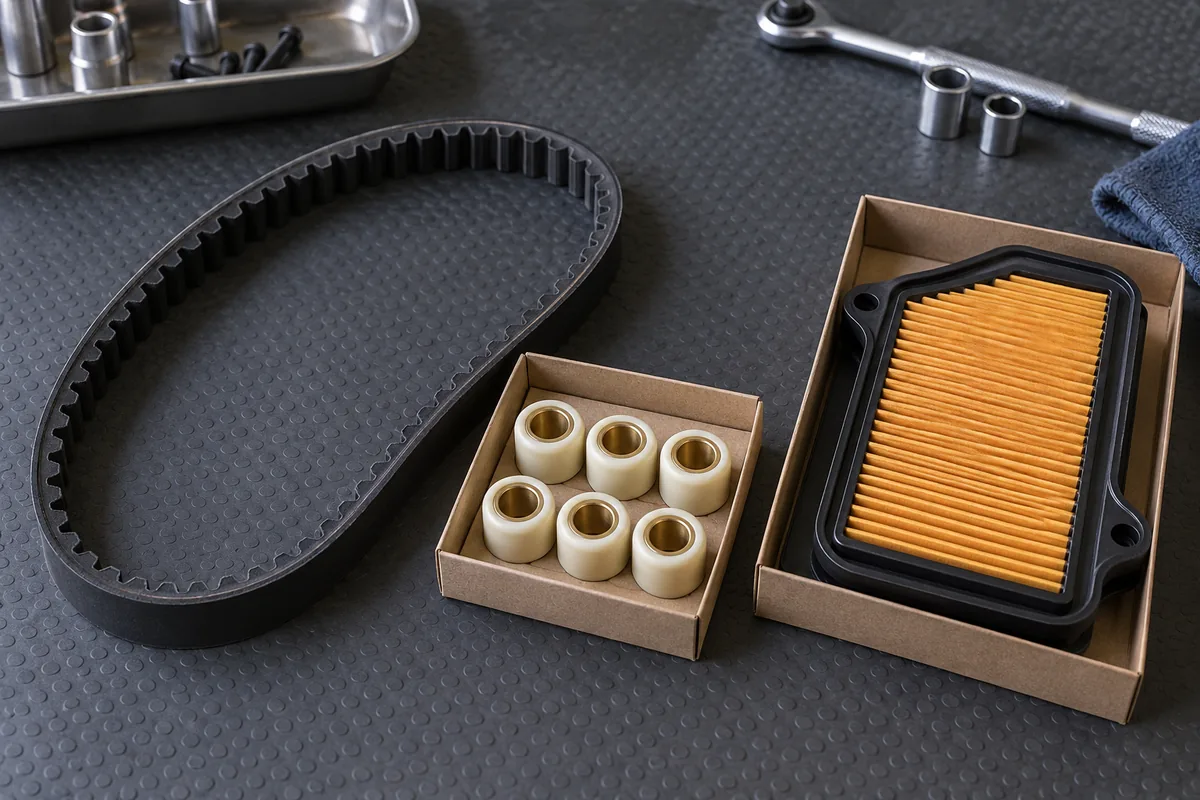
-
Belts A
need 8; import pack of 10 at USD 6 each costs USD 60. Local 8 × USD 16 = USD 128.
-
Roller sets B
need 10 complete sets; import pack of 10 sets at USD 3 each costs USD 30. Local 10 × USD 8 = USD 80.
-
Air filters C
need 12; import pack of 20 at USD 2 each costs USD 40. Local 12 × USD 5 = USD 60.
-
Import goods subtotal
USD 130 for 40 service units. Local goods subtotal: USD 268 for 30 units needed now. The import leaves two belts and eight filters as surplus stock.
In this guide
First define the service units
Assume a UK workshop’s next eight-week plan calls for eight belts for application A, ten complete roller sets for application B and 12 dry air-filter elements for application C. These are planning assumptions, not a claim about annual workshop demand. A, B and C are placeholders for three separately verified part applications.
For each belt record the catalog reference and length convention; for each roller set record dimensions, mass per roller and set count; for each filter record housing/seal geometry and specification. No “universal GY6” interchange is assumed. The initial basket contains no batteries, fluids, aerosols or fuel residue.
Illustrative purchase prices and pack rounding
- Belts A: need 8; import pack of 10 at USD 6 each costs USD 60. Local 8 × USD 16 = USD 128.
- Roller sets B: need 10 complete sets; import pack of 10 sets at USD 3 each costs USD 30. Local 10 × USD 8 = USD 80.
- Air filters C: need 12; import pack of 20 at USD 2 each costs USD 40. Local 12 × USD 5 = USD 60.
- Import goods subtotal: USD 130 for 40 service units. Local goods subtotal: USD 268 for 30 units needed now. The import leaves two belts and eight filters as surplus stock.
Compare the same delivery destination
All figures are USD and assume currency conversion is included. Local prices and import allowances are treated as non-recoverable cash; no VAT recovery is assumed. The destination is the same UK workshop postcode, with ordinary delivery access. Duty/tax is a placeholder allowance, not a UK tariff calculation.
Local exact-quantity total: goods USD 268 + delivery USD 12 = USD 280.
Combined-import total: goods 130 + China domestic transport 18 + sourcing/catalog/sample-review allowance 30 + inspection 15 + repacking 12 + international freight 50 + duty/tax allowance 30 + clearance/final-delivery allowance 20 = USD 305.
Separate-import comparison: keep every assumption the same except packing USD 9 and international freight USD 95, giving USD 347. Under this simplified scenario, consolidation is USD 42 below separate imports, but USD 25 above local purchase. Actual separate consignments may also change clearance or tax treatment; those differences are deliberately not modelled here.
Replace the freight placeholders with package evidence
No measured cartons or route quotes support the example’s USD 50/95 freight inputs. Ask for gross weights and protected outer dimensions after packing. Roller sets may be compact while filter cartons occupy more space; the combination must protect both and retain variant labels.
DHL Express describes comparing actual and dimensional weight, with separate package calculations. The booked carrier’s divisor, rounding, limits and surcharges control your real cost. A combined carton is not automatically charged on the goods’ net weight.
DHL Express UK: weight and dimensions; check the booked service (reviewed 2 October 2026) ↗
Check turnover before treating extra stock as value
The extra inventory has an assumed purchase cost of USD 28: two belts × USD 6 plus eight filters × USD 2. The example gives it no automatic resale credit. It will help only if later jobs use exactly those applications within suitable storage and service conditions.
Build a simple SKU ledger: confirmed jobs/demand, usable stock, stock already on order, expected replenishment time and explicitly chosen safety stock. Round only after calculating the quantity needed. Review slow variants separately from fast ones.
If four additional application-A belt jobs are actually confirmed, a separate scenario can value those needs. Do not create extra demand just to justify a carton. Follow the manufacturer’s storage and replacement guidance rather than inventing a shelf life.
Keep a battery or oil product out of the ordinary basket decision
Suppose the workshop also needs one battery. Illustrative local cash cost is USD 45; an accepted separate import is assumed at goods USD 20 + compliant preparation USD 15 + transport/surcharge USD 35 + duty/clearance/delivery USD 10 = USD 80. These are invented comparison inputs, not evidence that any battery or service is accepted.
The example would choose local supply for that battery while evaluating dry consumables separately. Adding the battery to either option gives USD 325 for local dry parts plus local battery, or USD 350 for the combined dry import plus local battery. Do not mix it into the dry-parts quote without a fresh acceptance and cost review.
For an actual lithium battery, use current IATA classification/packing guidance and the carrier’s acceptance. For lead-acid, fluids or fuel residue, use the item-specific screening in the shipping guide.
IATA: battery guidance for the 2026 regulations (reviewed 2 October 2026) ↗
Set the missing-part and validation boundary
The USD 30 review allowance is only a budget input. Define the actual catalog checks, samples/postage, interface measurements and any specialist work required. No allowance in this example represents durability testing or a guarantee of compatibility.
If two needed belts arrive unusable, emergency local replacement at the assumed USD 16 each plus USD 12 delivery adds USD 44. This is a sensitivity case, not a predicted defect rate. Downtime, installation labour, returns and unknown failures are not included in the base totals.
Buy the urgent quantity locally when a missed delivery would disrupt booked jobs. For future replenishment, request exact-quantity and pack-rounded quotes, use the landed-cost calculator, and send the fitment sheet, stock requirement, destination and required date through the sourcing form.
Questions & answers
Common questions
- Should I buy a season of belts in one go?
- Only if demand for each confirmed application supports it and the complete delivered cost is worthwhile. This example assumes eight weeks, not a universal stocking rule.
- Why can the local order win despite higher unit prices?
- It supplies exactly the immediate demand and avoids this scenario’s import verification, packing and freight overhead. Different real inputs can change the result.
- Can I count every roller as a stocked service unit?
- Keep purchasing and service units explicit. If a repair needs a full set, compare complete sets with the specified number and mass of rollers, not an attractive price per piece.
Your next step
Have a link you want checked?
Send a 1688 or Taobao product link and you get back the specification in English, the supplier check, and the landed cost to your country before you commit to anything.
Get a quote