Motorcycle and scooter parts / Buying guide
139QMB 669 vs 729 CVT Belts: Fitment Checklist
Last updated
Published by 1688 Moto Parts · Review method
Key takeaways
- Identify the installed CVT configuration and keep service replacement separate from tuning.
- Match belt, roller, variator and clutch lines independently using the evidence table.
- Hold unresolved SKU, dimension or kit-content differences before approving an order.
For 139QMB scooters, 669 and 729 can describe different CVT belt lengths. Scooterworks lists a 669-18-30 short-case example and a 729-17.7-30 long-case example. Confirm the installed transmission and the offered part number before ordering.
For a routine service order, identify the installed transmission and restore its specified configuration before considering tuning. “GY6”, displacement and a photograph of a similar assembly do not identify every belt, roller, variator or clutch variant.
Create a separate line for each service component. The table below shows what to send a supplier, what its response must identify and when to hold a line for further checking.
Turn this guide into a buying request
Keep this page as context. Add what you know; review everything before sending. No purchase is made at this step.
Continue to request →
-
Mark the affected buyer line “held” and write the conflicting evidence, such as catalog reference versus supplier SKU, roller count or an unidentified kit component.
-
Ask for a labelled photograph, the missing specification and a revised line-level confirmation. If the installed transmission differs from the catalog, have a competent technician identify that configuration.
-
Do not approve the entire basket because its belt line matches. Release only the separately confirmed lines and keep the held items out of the production quantity.
-
At receiving, compare markings, contents and agreed checks with the approved line. Segregate a mismatch and resolve it against the saved specification before distributing it to workshop jobs.
Compare these two catalog examples
Suppose a workshop logs 139QMB and an old belt marked 669, while a seller offers 729. Mark that quote line pending. Send the full old marking, transmission-case photos, any known modifications and the original catalog reference. Ask for the offered manufacturer SKU, length convention, width and specified angle, and a written application match. If the installed case differs from the catalog, have a qualified technician confirm it before approving a sample or bulk order.
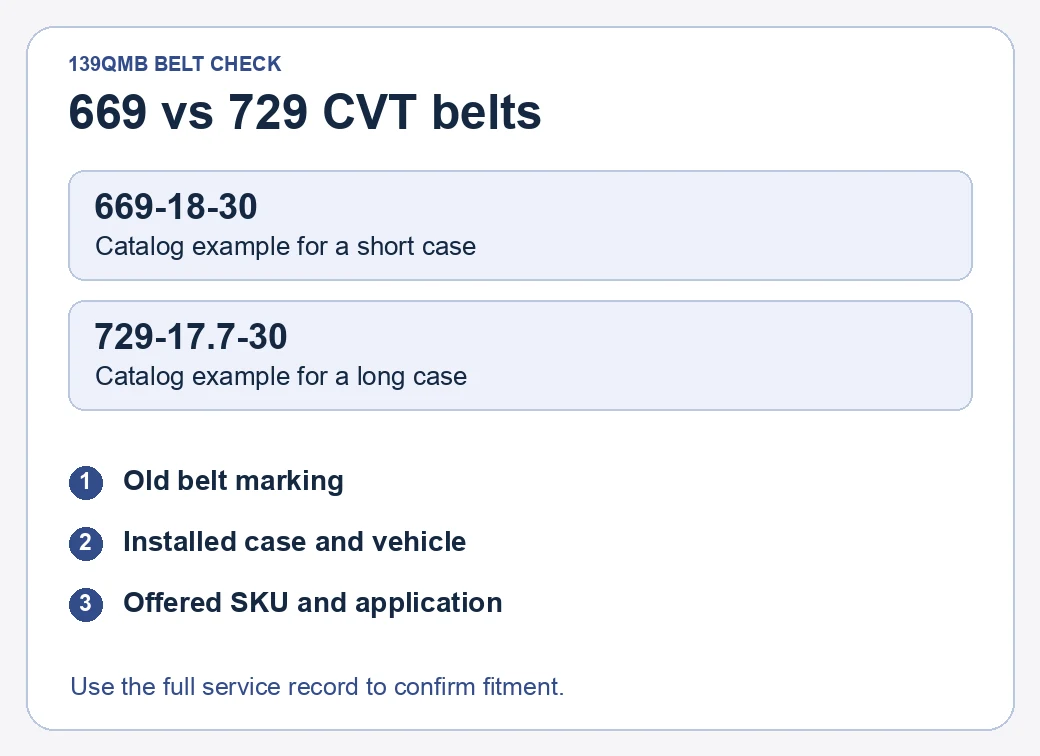
These dimensions are for the two named catalog products. Model labels, wheel size or measurements from a worn belt alone cannot establish fitment.
In this guide
Record the installed configuration before choosing parts
Start with the scooter model/year/market, full engine marking, case/transmission variant and catalog or service-manual reference. Record any previous variator, pulley, clutch or engine changes; the original vehicle listing may not describe a modified transmission.
Photograph the old component’s full markings and label the measurement points. Keep the original reference, installed part identity and supplier’s proposed replacement in separate fields so a proposed substitute does not overwrite your starting evidence.
Match each service line to its own evidence
Use manufacturer information for the required specification. Measurements of removed parts are supporting evidence, especially when parts are worn. Record units and measurement convention; do not treat an unlabelled dimension in a listing as a confirmed match.
| Service part | Evidence to send | Supplier response needed | Hold the line when |
|---|---|---|---|
| Belt | Vehicle/transmission application; catalog reference; full belt marking; known modifications | Offered maker/reference; supported application; specified dimensions and length convention where supplied | Only an approximate length or an anonymous “GY6 belt” is offered |
| Roller set | Variator reference; specified diameter, width, mass, profile/type and set quantity | SKU; dimensions; mass per roller; roller count per quoted set | Mass, profile or complete set quantity differs or is unconfirmed |
| Variator | Assembly reference; shaft/boss interface; pulley dimensions; offset and required hardware | Offered assembly identity; interface match; compatible roller specification; included hardware | The reply confirms only displacement or appearance |
| Driven pulley / clutch / bell | Exact assembly references; shaft/spline interfaces; bell working dimensions and specified clearances | Identity of each offered component; application match; complete assembly or individual-part contents | An assembly is split or substituted without confirming the mating components |
Identify a belt by application, then check the offered product
A worn belt may have changed dimensions. Its marking and measurements help identify a candidate, but outside circumference alone cannot establish the replacement. Length can use different reference conventions, and similar advertised dimensions do not establish identical construction or application.
Use the vehicle’s service information and the belt maker’s application resources. Gates provides scooter-specific PowerLink products and application resources; that does not validate an anonymous belt bearing a similar number. Ask the supplier to identify the actual offered maker/reference and retain its application evidence.
Keep service replacement and tuning on different records
The variator and driven pulley change the belt’s working ratio; rollers influence variator movement, and the clutch controls drive engagement. Polini’s technical workbook illustrates how roller and spring choices interact with the engine’s operating range in its tuning examples.
A service replacement should follow the specified configuration. A proposal to change roller mass, springs or the variator needs a separate application, operating goal and specialist evaluation; a belt catalog match does not approve those changes. Heavier rollers do not guarantee higher top speed, and lighter ones do not guarantee better acceleration.
Ask for the spring’s product/application reference rather than choosing by colour. Record a tuning baseline and controlled results if a specialist changes the setup, and check local road-use, insurance and warranty requirements.
Polini Motori: transmission technical workbook (checked 23 October 2026) ↗
Hold unresolved differences instead of ordering a near match
- Mark the affected buyer line “held” and write the conflicting evidence, such as catalog reference versus supplier SKU, roller count or an unidentified kit component.
- Ask for a labelled photograph, the missing specification and a revised line-level confirmation. If the installed transmission differs from the catalog, have a competent technician identify that configuration.
- Do not approve the entire basket because its belt line matches. Release only the separately confirmed lines and keep the held items out of the production quantity.
- At receiving, compare markings, contents and agreed checks with the approved line. Segregate a mismatch and resolve it against the saved specification before distributing it to workshop jobs.
Download: motorcycle parts RFQ worksheet with CVT service fields ↗
Turn confirmed applications into a workshop service order
Distinguish individual rollers from complete sets and list each kit’s included boss, guides, washers or other hardware where applicable. Keep variants in labelled inner packs linked to the buyer line and supplier SKU. Replenish using observed jobs per confirmed application, usable stock and pack multiples.
Use the vehicle and component manufacturer’s service intervals, inspection limits and installation instructions for the operating conditions. There is no universal belt replacement interval for all scooters. Follow the specified torque and replacement requirements; do not run exposed rotating transmission parts for a visual test.
Questions & answers
Common questions
- Can I match a belt by measuring the old one?
- Use its markings and measurements as supporting evidence. Wear and length conventions can mislead; establish the catalog/application reference and identify the actual offered replacement.
- Will a 150 cc variator fit a 125 cc scooter?
- Displacement labels do not settle shaft, boss, pulley, ramp or clearance compatibility. Confirm the exact assembly and its mating components.
- What should I do when the supplier’s roller set differs from the service record?
- Hold that line and request confirmation of diameter, width, profile, mass per roller and set count for the installed variator. Treat a proposed tuning change as a separate decision.
Your next step
Have a link you want checked?
Send a 1688 or Taobao product link and you get back the specification in English, the supplier check, and the landed cost to your country before you commit to anything.
Get a quote