Lower Shock Bearing Kits: Keep the Package Title Narrow
Describe a lower shock-mount bearing kit accurately on a new outer pack. Do not turn its limited contents into a complete shock-rebuild claim.
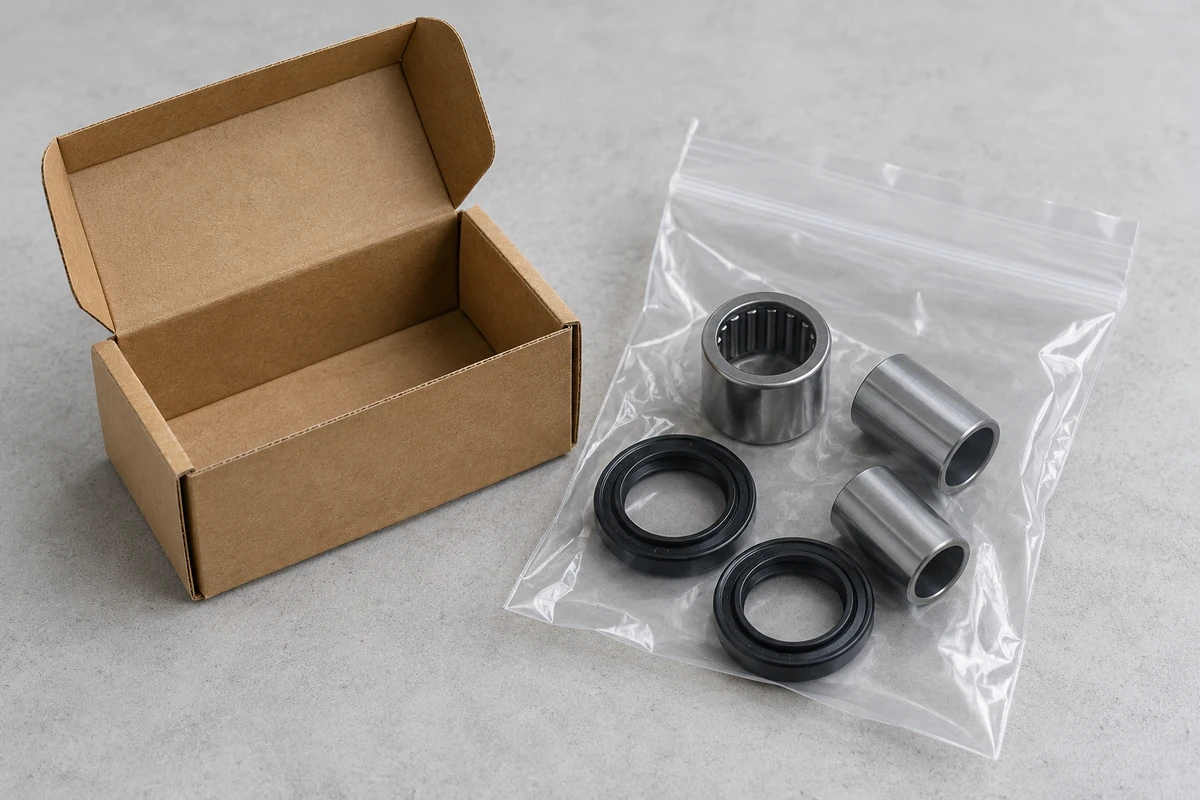
A new outer title can enlarge a product's apparent scope without adding a single component. When a lower shock-bearing kit is repacked, keep its mount-specific identity visible. 'Complete shock rebuild' is a different claim from the lower-mount supply the buyer may actually have ordered.
The exact kit and its application should already be approved. This review compares recipient-facing package language with the accepted contents and mount scope. It provides no bearing-fitting, shock-servicing or repair-completeness assessment.
Read the application scope beside the contents
All Balls Racing's 27-1089 record identifies a lower rear shock-bearing application and lists bushings, seals and a spherical bearing. Those named-product observations were checked on 14 October 2026. They support a limited mount-kit description, not a statement that every part required to rebuild a shock is supplied. All Balls 27-1089 product record
For the actual offer, retain the provider's exact title, application scope and contents issue together. A contents table detached from the lower-mount description can invite a broader interpretation. A short box title detached from the table can do the same.
Do not create an expanded technical list of excluded shock internals from memory. The immediate task is to avoid claiming a scope the provider has not established. Where an exclusion needs clarification for the intended recipient, ask the product-information owner to supply accurate wording.
Review more than the largest headline
Check the front title, side label, sleeve description and any recipient insert against the same baseline. A front panel saying lower bearing kit can still conflict with a side panel promising full rebuild coverage. One corrected phrase does not resolve every appearance of the broader claim.
Keep the word complete attached to its actual object if it is used at all. 'All ordered contents present' is a packing declaration. 'Complete shock rebuild' describes a technical repair scope. The first does not establish the second, and a product image cannot supply the missing evidence.
A buyer's bundle name should not erase mount location. If several separately ordered items are combined in one retail package, identify that combination from its actual accepted schedule rather than relabeling the original mount kit as a comprehensive repair product.
Fictional example: a mount kit becomes an entire rebuild
Imagine fictional order L-11 for an approved lower-mount kit. The provider's contents record is complete at that defined scope. A new sleeve calls the pack 'full shock rebuild kit' because all listed pieces fit neatly inside. All references and claims in this scenario are invented.
The buyer returns the title for correction. Nothing in the piece count extends the supply to the whole shock. The issue does not require a technician to inspect or disassemble a shock; it can be identified by comparing the proposed claim with the accepted scope.
Suppose the designer changes the headline but leaves 'everything needed for your shock' in a small caption. That is still the same unsupported expansion. The reviewer should reconcile every recipient-facing statement before approving the artwork issue.
If the buyer actually wants a wider repair package, record that as a separate requirement for the responsible technical provider. Do not solve the marketing problem by inventing additional contents or asking the packer to decide what a whole rebuild needs.
Use a claim-to-contents worksheet
This is an original purchasing worksheet, not a technical standard or an instruction to handle the product.
| Review field | Record or request |
|---|---|
| Exact lower-mount kit | Accepted code and controlling provider title |
| Provider contents | Actual included groups and schedule issue |
| Mount scope | Lower-mount or other exact documented application boundary |
| Proposed outer title | Every broader claim and its artwork location |
| Excluded shock internals | Only provider-established exclusions; no invented BOM |
| Corrected label | Approved bounded wording and issue superseded |
Attach each problematic phrase to its location and artwork revision. The correction should be traceable so an obsolete sleeve does not return at the next packing handover. Keep proposed text separate from final approved text until the relevant owner has accepted it.
A precise lower-mount description also should not become an unverified fit guarantee. Preserve actual application qualifications without expanding the named manufacturer's record to other models, years or suppliers. The documentary example is not an offer of that branded kit.
Close the label scope, not the technical job
The final package title should accurately describe the approved lower-mount supply and its established contents. Record any outstanding application or contents uncertainty separately rather than using the word complete to cover it.
This narrow approval helps the recipient understand the purchased product. It does not establish shock condition, completeness of a repair plan or readiness for use. If the provider later changes the kit reference or adds another group, review the affected description again instead of carrying the old title forward by habit.
Bring the exact change into the sourcing request
See Dirt bike parts for product context. A Motoparts sourcing request should identify the accepted product, the proposed packing change and the unanswered decision above. Motoparts provides independent aftermarket and unbranded buying coordination and supplier negotiation. Named manufacturers are documentary examples, not branded-supply offers, affiliations or evidence of another provider's capability.
The initial form supports a supported-marketplace HTTPS link, an 8–1200-character description or screenshots. It accepts up to five PNG, JPEG, WebP or GIF images, at most 10 MiB each and 20 MiB combined. PDF, CAD and ZIP files require a separately agreed authorized exchange. The form is not a technical-file portal; a request does not establish engineering approval or a specialist packing service.
Frequently asked questions
Can a lower shock-bearing kit be called a complete shock rebuild?
Only a separately established full repair scope could support that broader claim. The named mount-kit contents do not. Keep the lower-mount description visible and obtain accurate provider wording for the actual purchased product.
Does a complete piece count justify complete-rebuild wording?
No. Count addresses supplied membership within the accepted kit. Repair completeness is a different technical claim, and the presence of all ordered pieces does not expand the purchase to the whole shock.
Should the label list every excluded shock component?
Do not invent an exclusion list from general knowledge. Identify the actual scope and ask the product-information owner which explicit exclusions are needed for clarity. Unsupported broad claims should be removed rather than balanced with guessed details.
Is correcting the front title enough?
Check all recipient-facing text, including side panels and captions. A narrow headline can still be contradicted by a full-rebuild promise elsewhere. Approve a consistent artwork revision tied to the accepted contents record.