Motorcycle and scooter parts / Buying guide
Buying Chinese motorcycle parts: compare quotes and approve each SKU
Last updated
Published by 1688 Moto Parts · Review method
Key takeaways
- Link each required application to a named offered SKU and keep missing supplier answers visible.
- Compare identical pieces, sets or kit contents, then include pack multiples and delivery exclusions.
- Keep sample evaluation separate from production approval and preserve the agreed specification for reorders.
A marketplace listing is a sourcing candidate. Before ordering, link the actual vehicle and replacement requirement to one offered supplier SKU, then record what has been confirmed and what is still missing.
This guide is for a buyer comparing suppliers for a defined parts basket. Use the component guides for identification; use the checklist below to obtain comparable answers and decide which lines can progress to samples or a production order.
Turn this guide into a buying request
Keep this page as context. Add what you know; review everything before sending. No purchase is made at this step.
Continue to request →-
Buyer line ID
[ ]; vehicle/model/year/market: [ ]; known modifications: [ ]; full engine marking, if relevant: [ ].
-
Required part and catalog reference
[ ]; catalog/service source: [ ]; attached labelled photos and dimensions: [ ]; unresolved identification questions: [ ].
-
Supplier to confirm
offered SKU [ ]; application evidence [ ]; differences from our requirement [ ]; any requirement you cannot confirm [ ].
-
Required quantity
[ ] pieces / sets / kits; one quoted unit must contain [ ]; accessories and hardware included [ ]; MOQ and pack multiple per SKU [ ].
In this guide
Build one buying record per application and component
Give each line your own buyer reference. Record the vehicle manufacturer/model, year or build information, market, known modifications, full engine marking where relevant and original part reference. Keep suffixes; an engine-family name such as GY6 is a search aid, not an interchange decision.
Attach the catalog or service-information reference and labelled photographs. Ask the supplier to name the exact offered SKU and respond to each requirement. Keep a missing answer visible as “unconfirmed”; a listing photograph should not silently become the specification.
Compare suppliers against the same RFQ line
Copy the same requirement to each supplier and retain each response with its date. Use the table as a comparison sheet; blank cells and differences need resolving before a lowest-price comparison is meaningful.
| Comparison field | Your required basis | How to compare the responses |
|---|---|---|
| Product identity | Buyer line ID; application; required catalog reference; offered SKU | Require a named offered SKU for each application; a generic family label leaves the offer unconfirmed. |
| Compatibility evidence | Catalog/application match, labelled photos and component-specific checks | List each supported requirement and unresolved difference; do not score missing evidence as a match. |
| Quoted unit | One piece, complete set or kit; exact contents and quantity per unit | Compare identical contents. Request a revised quote when one offer omits a required component. |
| Order quantity | Required units; MOQ per SKU; pack multiple; surplus units | Calculate usable quantity and surplus for each offer; do not assume mixed variants share one MOQ. |
| Sample basis | Sample SKU and contents; checks required; sample cost and dispatch terms | Confirm the sample is the offered production variant and distinguish sample charges from bulk prices. |
| Production basis | Agreed specification/version; batch identification; substitutions; inspection | Link the proposed batch to the agreed specification and record whether substitutions need approval. |
| Cost and timing | Currency; quote validity; packing; included transport; ready date; excluded charges | Use the same currency and delivery scope; leave excluded or unknown charges visible. |
| Mismatch terms | Evidence required, response time and agreed remedy for a nonconforming line | Compare the agreed remedy and evidence requirements before payment, rather than relying on a listing promise. |
Copy this ready-to-fill RFQ checklist
Complete the bracketed fields before sending. For a mixed basket, repeat the product block for every line rather than asking for one generic motorcycle-parts kit.
- Buyer line ID: [ ]; vehicle/model/year/market: [ ]; known modifications: [ ]; full engine marking, if relevant: [ ].
- Required part and catalog reference: [ ]; catalog/service source: [ ]; attached labelled photos and dimensions: [ ]; unresolved identification questions: [ ].
- Supplier to confirm: offered SKU [ ]; application evidence [ ]; differences from our requirement [ ]; any requirement you cannot confirm [ ].
- Required quantity: [ ] pieces / sets / kits; one quoted unit must contain [ ]; accessories and hardware included [ ]; MOQ and pack multiple per SKU [ ].
- Sample request: [ ] units of SKU [ ]; agreed checks [ ]; sample cost and dispatch terms [ ]. Do not substitute another SKU without written agreement.
- Production request: [ ] units; agreed specification/version [ ]; batch and inner-pack labels [ ]; inspection plan [ ]; mismatch remedy [ ].
- Quote currency and validity: [ ]; goods-ready date: [ ]; packing dimensions/weight: [ ]; destination/postcode: [ ]; included charges and exclusions: [ ].
Download: editable motorcycle parts RFQ and quote comparison worksheet ↗
Separate a sample decision from production approval
Use explicit line statuses: identification incomplete, ready for quotation, sample evaluation, production approved or held. A supplier agreeing to send a sample only moves that line to sample evaluation. It does not approve the bulk order.
Record the sample SKU, identifying marks, received contents, check results and unresolved differences. Before production approval, agree which specification the order will follow, how the production batch will be identified and which receiving or pre-shipment checks apply. Keep the evaluated sample record linked to the purchase order.
Choose checks by component function. A successful fit check alone cannot demonstrate the fatigue strength or braking performance of a structural or braking part; obtain the appropriate application and specialist evidence before releasing those lines.
Normalize pieces, sets and kits before comparing cost
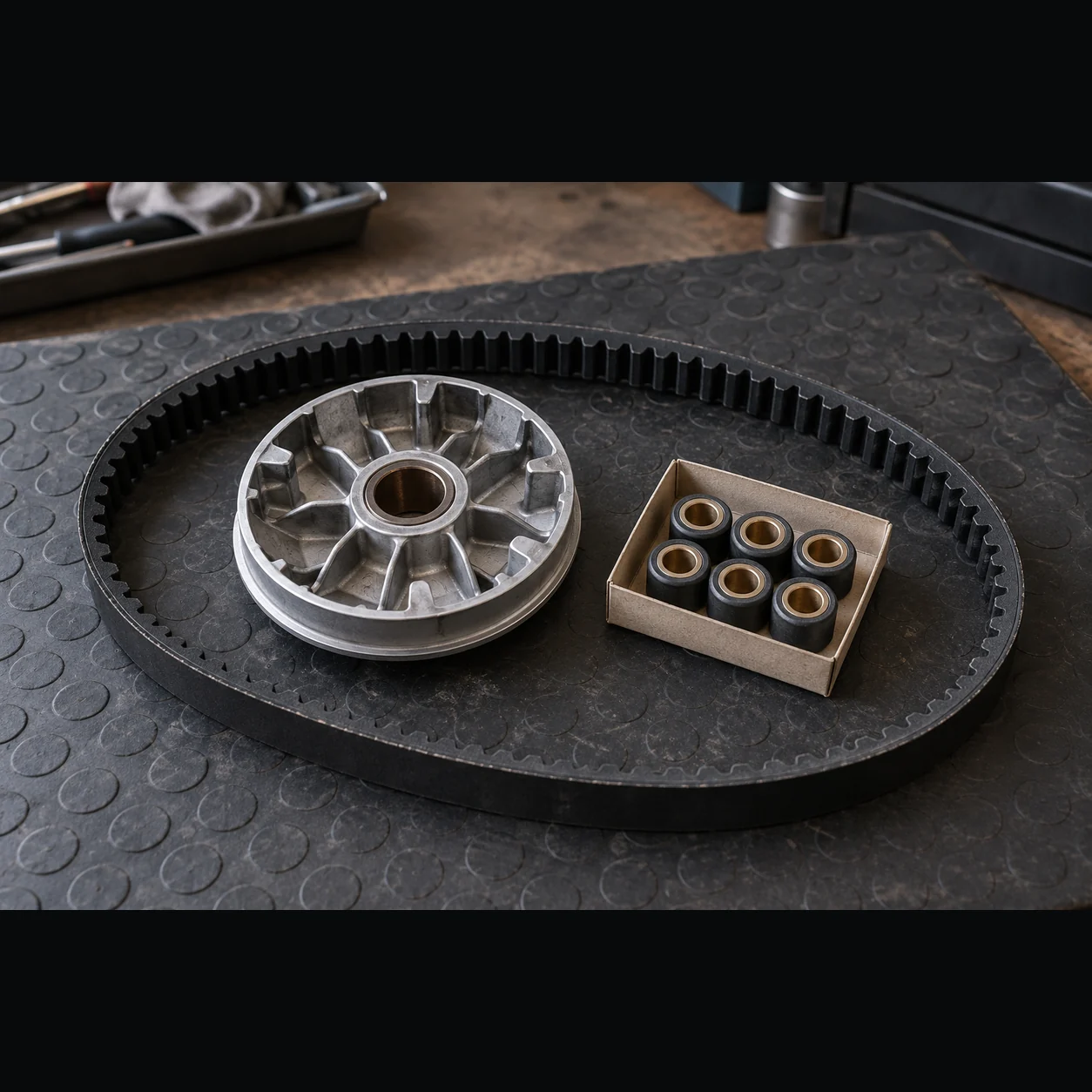
Write the included quantity next to the price: a roller, a complete roller set and a variator kit are different quoted units. List hardware and accessories explicitly. Do not divide a kit price into a piece price until its contents match the requirement.
Compare the quantity you can actually use, including minimums and surplus stock. Add sample evaluation, inspection, domestic collection, packing, freight, destination charges and delivery without counting the same charge twice. Keep unknown charges marked as unknown; do not invent a defect rate to make one quote look cheaper.
For an urgent repair or a very small order, compare a traceable local replacement against the complete import cost and expected ready date. A lower listing price does not settle that decision.
Resolve shipping exceptions before committing the basket
Keep ordinary dry service parts separate from batteries, aerosols, pressurized components and previously fuelled engines when requesting transport screening. Give the carrier the actual product condition and obtain item-specific acceptance.
For complete engines going to the United States, check import and emissions eligibility separately. EPA guidance covers new and used vehicles/engines, including nonroad applications; an “off-road” listing description does not settle eligibility.
US EPA: importing vehicles and engines (checked 23 October 2026) ↗
Keep the reorder tied to the approved specification
Save the supplier response, agreed SKU/specification, sample results, order terms and receiving findings together. On reorder, ask the supplier to confirm whether the product, materials, included contents or production source have changed before reusing an approval.
A motorcycle brand in a title may describe compatibility or a claim of genuine goods. Ask the supplier to state what is actually offered. Our sourcing scope is aftermarket and unbranded parts; an application reference should not imply original-equipment manufacture.
Questions & answers
Common questions
- Can I approve a supplier from one sample?
- A sample can support a decision about that identified product and the checks performed. Link it to an agreed production specification, batch identity and inspection plan; it does not establish that every future shipment will be identical.
- What if two suppliers quote different kit contents?
- Ask for a contents list and quantity per quoted unit, then request a revised quote against the same requirement. Keep unmatched offers separate until the usable quantities and missing items are clear.
- Can I source parts for a discontinued bike?
- Start with its exact variant and catalog references, then evaluate a supplier candidate. A familiar engine family alone cannot establish compatibility or current availability.
Your next step
Have a link you want checked?
Send a 1688 or Taobao product link and you get back the specification in English, the supplier check, and the landed cost to your country before you commit to anything.
Get a quote