
Custom Spoke Kits: Keep the Order Reference on the Pack
Give a made-to-order spoke-and-nipple kit a traceable package reference when no ordinary retail SKU identifies the approved custom configuration.
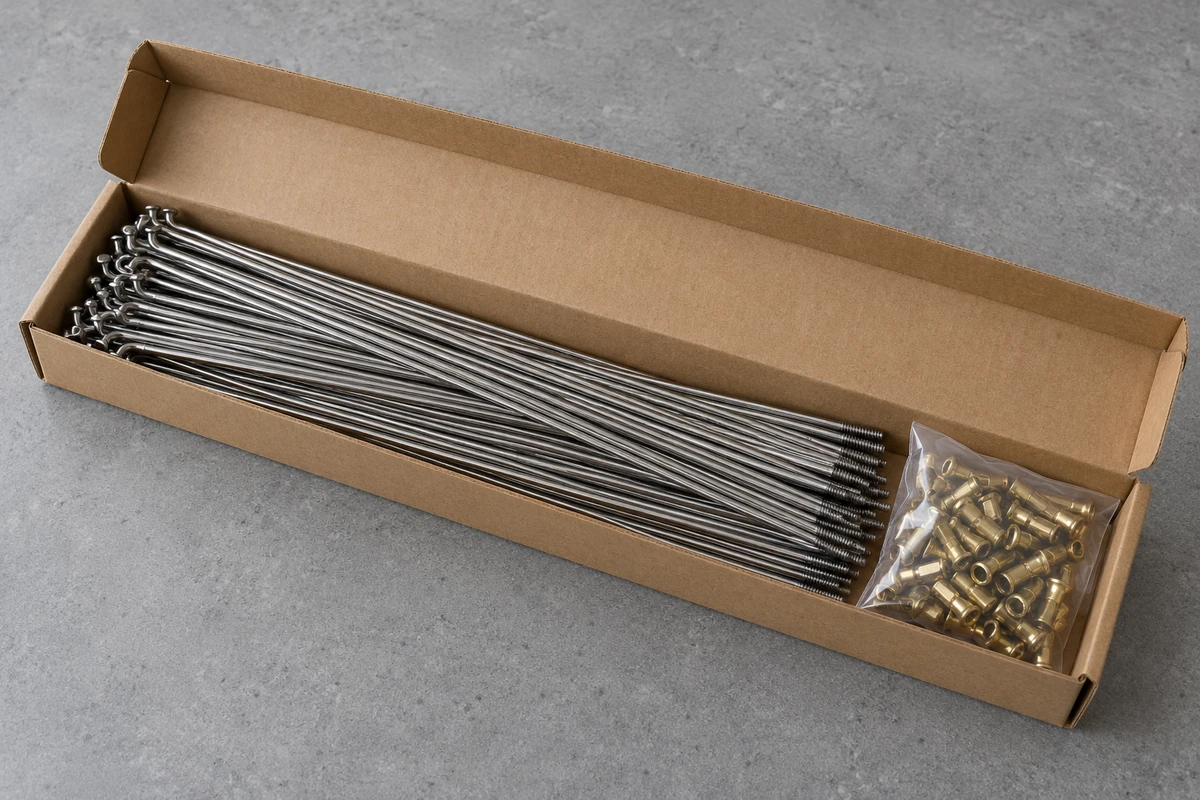
A custom spoke-and-nipple kit may arrive with a provider order reference rather than a familiar catalogue SKU. Consolidation should preserve that custom identity instead of replacing it with a broad label such as 'motorcycle spokes.' Before approving new packaging, decide which record lets the recipient recover the exact accepted order.
The wheel specification and component selection are assumed to be authorized already. This article does not choose spoke length, match threads, recommend a wheel build or give lacing instructions. Its outcome is a package-to-custom-order cross-reference.
Recognize the difference between a SKU and a custom order
Buchanan's distinguishes pre-packaged spoke kits, which have part numbers, from made-to-order kits. It also warns that spoke threads are not universal. Those statements, checked on 14 October 2026, explain why an ordinary catalogue code should not be invented for a custom supply. They do not identify the buyer's actual kit. Buchanan's spoke kits
Ask the actual provider which reference governs the custom job: an order number, quotation issue, approved specification or another attributable record. Keep that reference with any supplier-assigned package identification. If the provider genuinely assigns a product code, use it; if it does not, do not fill the field with a nearby pre-packaged kit number.
A buyer's internal stock code can be useful. Its purpose is to point to the custom order, not to assert that the provider sells that exact configuration as a catalogue product. Label the code's ownership clearly and maintain the cross-reference.
Preserve the accepted specification revision
A custom order may have changed between enquiry and approval. Use the accepted specification issue, including the authorized wheel or component record it references. Avoid printing a first-quote shorthand on the final package when a later accepted revision controls the supply.
Keep spoke and nipple group references connected to the same custom job where that is the approved relationship. The word matching should not be added merely because the two groups share a carton. Their technical relationship comes from the accepted provider documentation, not the consolidation arrangement.
If several custom kits are consolidated, identify each as its own order-defined unit. Two orders with similar visible spokes may still have different approved specifications. A master shipping label can locate the carton but cannot replace the kit-level route back to those specifications.
Fictional example: a stock code borrowed to fill a blank
Imagine fictional custom order Q-62 revision C, accepted after a documented specification change. The provider has not assigned a retail SKU. A packing spreadsheet requires a product-code field, so an operator enters the nearest-looking pre-packaged kit code. Nothing in this scenario describes an actual Buchanan's order.
That shortcut creates a false catalogue identity. The buyer instead records Q-62-C as the provider order basis and, if needed, adds a clearly administrative stock reference that links to it. The blank SKU field becomes 'not assigned by provider' rather than a guessed code.
Now suppose the nipple group remains labeled with the earlier revision B. The new outer label does not settle which revision that group actually represents. Ask the provider to reconcile the group with the accepted C record before marking the repacked kit complete. Do not infer equivalence from the unchanged color or a shared component count.
Build a custom-order package cross-reference
This is an original purchasing worksheet, not a technical standard or an instruction to handle the product.
| Review field | Record or request |
|---|---|
| Provider order reference | Actual custom job identifier and issuer |
| Approved wheel specification | Controlling accepted record and revision |
| Spoke group | Provider-linked supplied group |
| Nipple group | Associated group and any conflicting issue |
| Packaging parent | Final kit-level reference beneath the shipment carton |
| Provider cross-reference | Evidence connecting every new administrative code to the order |
The worksheet should work when read from either end. Given a package, the recipient should find the controlling custom-order record. Given an order, the buyer should locate the corresponding supplied spoke and nipple groups. If one group is deferred, state that explicitly without declaring the order complete.
Do not place confidential drawing information on an outer label simply because it is available. The label can carry the minimum agreed locating reference, while the authorized recipient accesses the relevant specification through the agreed records. No new public sharing or secure portal is implied.
Keep later reorders separate from this pack identity
The preserved reference can help the buyer ask about a later order, but it does not guarantee repeat availability, unchanged manufacture or suitability for a different wheel. The provider must confirm what it is offering against the relevant accepted specification at that time.
For the current packing decision, close only the cross-reference: custom order, controlling issue, included groups and package parent. It preserves a purchasing identity that a retail SKU cannot supply, while leaving technical design and physical protection with their responsible owners.
Bring the exact change into the sourcing request
See Dirt bike parts for product context. A Motoparts sourcing request should identify the accepted product, the proposed packing change and the unanswered decision above. Motoparts provides independent aftermarket and unbranded buying coordination and supplier negotiation. Named manufacturers are documentary examples, not branded-supply offers, affiliations or evidence of another provider's capability.
The initial form supports a supported-marketplace HTTPS link, an 8–1200-character description or screenshots. It accepts up to five PNG, JPEG, WebP or GIF images, at most 10 MiB each and 20 MiB combined. PDF, CAD and ZIP files require a separately agreed authorized exchange. The form is not a technical-file portal; a request does not establish engineering approval or a specialist packing service.
Frequently asked questions
What should identify a custom spoke kit without a retail SKU?
Use the actual provider’s order or accepted specification reference and its controlling issue. A buyer stock code may point to that evidence if clearly administrative. Do not borrow a nearby catalogue part number to fill a required field.
Can spokes and nipples share one custom-order label?
Only when the approved provider record establishes that relationship. Preserve the actual group references and any revision differences. Sharing a carton does not itself establish thread compatibility or a technically matched combination.
Does the package need the full wheel drawing printed on it?
Not necessarily. Agree the minimum locating reference and the authorized recipient’s access to the controlling record. Avoid exposing unnecessary drawing information; a package identity and a technical specification have different roles.
Can the preserved reference be used to reorder automatically?
It provides a precise starting point for a new enquiry, not a guarantee of continued availability or unchanged specification. Obtain the provider’s current confirmation for the actual repeat requirement before treating it as the same supply.
Sources
Discuss a sourcing request related to this article.Custom Spoke Kits: Keep the Order Reference on the Pack