
Rebuilt Stator Receipt: Reconcile the Returned Assembly
Compare the sent stator assembly, authorized work and returned elements before closing a rebuild receipt or accepting unexplained changes.
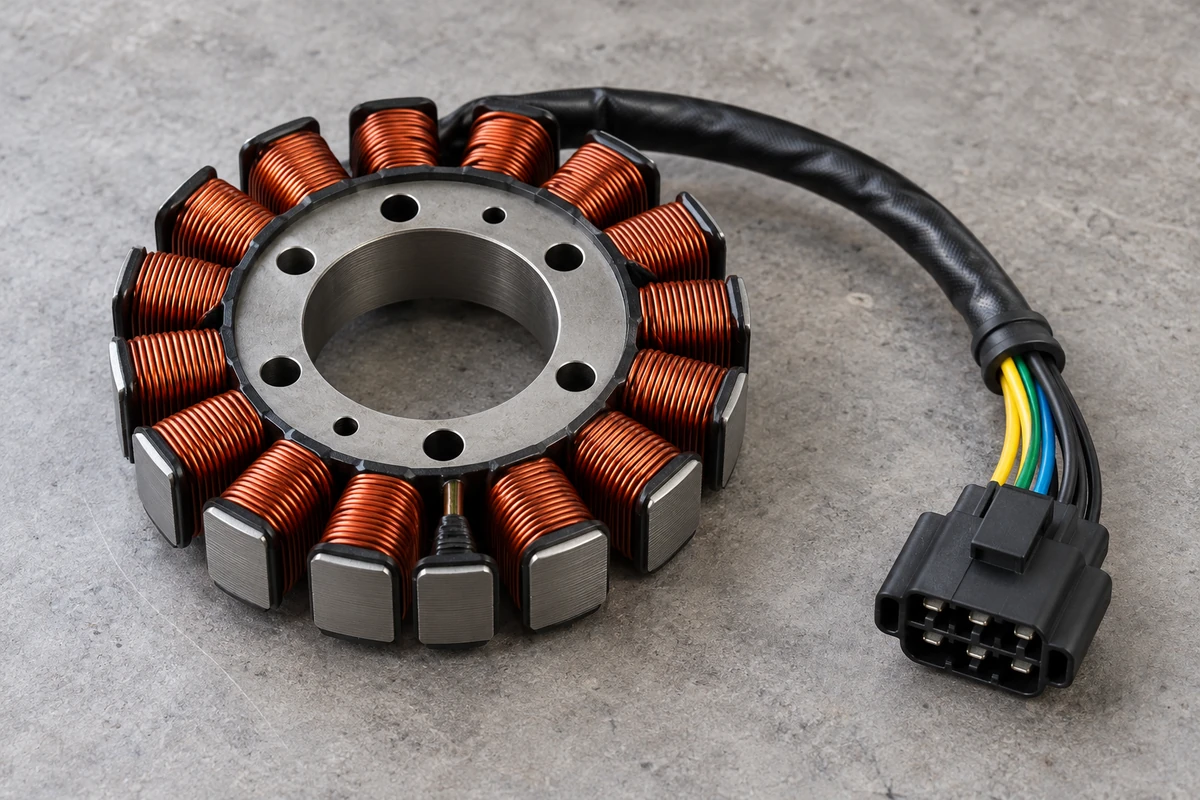
A rebuilt stator receipt should reconcile more than the appearance of its windings. Match the returned assembly to the sent-core record, the work actually authorized and the elements expected back. A fresh-looking coil does not explain an undocumented connector change or an unaccounted-for grommet.
This is a closed-loop job-record review. It does not select a rebuilding service, assess electrical performance, define regulator architecture or tell a buyer how to test the stator.
Recover the sent-core baseline
Start with the job number, the core identity acknowledged by the service provider and the original sent-assembly schedule. Keep the intake acknowledgment beside the sender’s record. If they differ, preserve the difference rather than assuming the provider received everything the sender intended to send.
List the assembly elements actually documented: plate, coils, grommet, wiring and connectors or terminals as applicable. Use the exact job record, not a generic picture of a complete stator. Existing images can support identity, but a hidden component should remain unconfirmed if the record does not establish it.
Record any elements explicitly excluded from the job. An incomplete initial record is a real limitation; it should not be repaired by calling an unexplained returned piece original merely because it resembles the sender’s memory.
A partial repair can involve a broader physical assembly
Rick’s Motorsport Electrics’ custom-rebuild policy requires the stator plate, grommet, coils, wiring and connectors or terminals with the core, even for an individual-coil rebuild. This is a requirement of that named service. It illustrates why the assembly handed over may be broader than the specific work authorized. Rick’s custom-rebuild policy
It does not establish what another rebuilder received, what it agreed to return or what Motoparts can rebuild. This article does not repeat the service’s prices, lead times or warranty terms. Use the actual accepted job terms for the commercial relationship being reconciled.
Map authorized work to each returned element
Keep three distinct records: the sent assembly, approved work and returned assembly. An element can be present in the first and third records without having been included in the repair scope. Conversely, a part may have been replaced under an explicit change authorization and should not be described as the retained original.
For every declared change, preserve who approved it, the affected element and the job-record reference. “Rebuilt as necessary” may not identify which items changed. Ask the service provider for its actual work declaration rather than inferring scope from the new appearance of one component.
Compare the return note with the received identity. If the note lists an original connector while existing receipt evidence appears different, record the conflict. A service invoice alone does not resolve what physical item was returned, and a photograph alone does not establish electrical equivalence.
Buyer worksheet
Use one record per identified unit or clearly defined affected group. This is an original purchasing aid, not a test procedure or acceptance standard.
| Field | Record to preserve | Question that remains open |
|---|---|---|
| Core receipt identity | Sender record, provider acknowledgment and job number | Conflict between what was sent and acknowledged |
| Sent assembly schedule | Documented plate, coils, grommet, wiring and connectors | Unrecorded elements assumed present |
| Authorized work | Accepted scope and each approved change reference | Fresh appearance treated as a work report |
| Returned elements | Item-by-item physical/document association | Missing element versus unexplained substitution |
| Declared changes | Actual replaced or retained identity and approval record | Changed connector assumed electrically equivalent |
| Unresolved ownership | Actual retention/return terms and accountable provider reply | Disposition of original pieces inferred without agreement |
Keep missing and substituted elements as different questions
An element not accounted for in the return schedule raises a reconciliation question. A documented substitution raises a change-scope question. Do not combine both under “incomplete rebuild” when the records require different supplier answers.
Ask whether an unaccounted-for item was retained, replaced, excluded or simply not listed, and request the actual supporting record. Do not infer ownership or a right to disposal from this worksheet. Original-part retention and return arrangements depend on the accepted job agreement and actual authorization.
For a substitution, request the changed item identity and the relevant technical approval record. Do not connect, probe, energize or modify the returned assembly to decide whether a different connector is acceptable. Electrical suitability remains with the appropriately qualified provider.
Fictional example: a new winding does not answer the connector question
Imagine fictional job S-21 authorizing a partial-coil rebuild. The sent record includes an identified connector, while the returned assembly appears to have a different connector and the service note does not explain the change. The scenario is invented and reports no real service failure.
The buyer first asks the rebuilder to reconcile the returned connector with S-21’s job history. The reply should establish whether the observation reflects a documented replacement, an identity error or another issue. A photo of clean windings is not responsive to that question.
If a replacement was authorized, the receipt record can be updated with the actual approval and changed-item reference. If authorization is missing, preserve the proposed resolution as pending. Neither path should be shortened to “stator tested good” unless a real, applicable test report exists and its scope is accurately recorded.
Close the handback without inventing performance evidence
A completed assembly reconciliation identifies every relevant returned element, documented change and remaining question. Attach the actual work report and any separate assessment supplied. If a report covers electrical results, preserve its issuer, method reference and product identity rather than making broader claims.
The buyer may be able to close a missing-document issue while a technical assessment remains pending. That is a valid limited outcome. Receiving the correct pieces and receiving a serviceable electrical assembly are different conclusions, and the records should make both statuses visible.
Keep the request tied to the received item
Use the ATV parts category for product context and the Motoparts sourcing request for the exact received reference and unresolved supplier question. Motoparts provides independent aftermarket and unbranded buying coordination and supplier negotiation. The manufacturer example above is documentary evidence, not a branded-goods offer, affiliation, inspection-service promise or engineering approval.
The sourcing form supports a supported-marketplace HTTPS link, an 8–1200-character description, or one or more screenshots. Image limits are five PNG, JPEG, WebP or GIF files, 10 MiB per file and 20 MiB combined. It does not accept PDF, CAD or ZIP uploads. Arrange other technical files only through a separately agreed, authorized exchange.
Frequently asked questions
Does a partial-coil rebuild mean only a coil was involved in the handover?
Not necessarily. Rick’s named service requires the broader stator assembly even for an individual-coil rebuild. The actual sent schedule and accepted terms determine the scope of your own job.
Does a different returned connector prove the wrong stator came back?
It identifies a discrepancy to reconcile, not a complete diagnosis. Compare the sent-core identity, authorized changes, work declaration and returned assembly before drawing a conclusion.
Can I plug in the rebuilt stator to verify a substitution?
No connection or electrical test is authorized here. Request the changed-item identity and appropriate technical evidence, and leave electrical suitability to the qualified provider.
What if an original part was not returned?
Ask the service provider to account for it against the job record and actual retention or return agreement. Do not infer that it was discarded, replaced or lawfully retained from its absence alone.
Sources
Discuss a sourcing request related to this article.Rebuilt Stator Receipt: Reconcile the Returned Assembly