
Drum Brake Arcing Handover: Preserve the Matched Assembly
Connect a serviced drum with the shoe and backing-plate assembly matched to it, including the wheel-work event that defines the relationship.
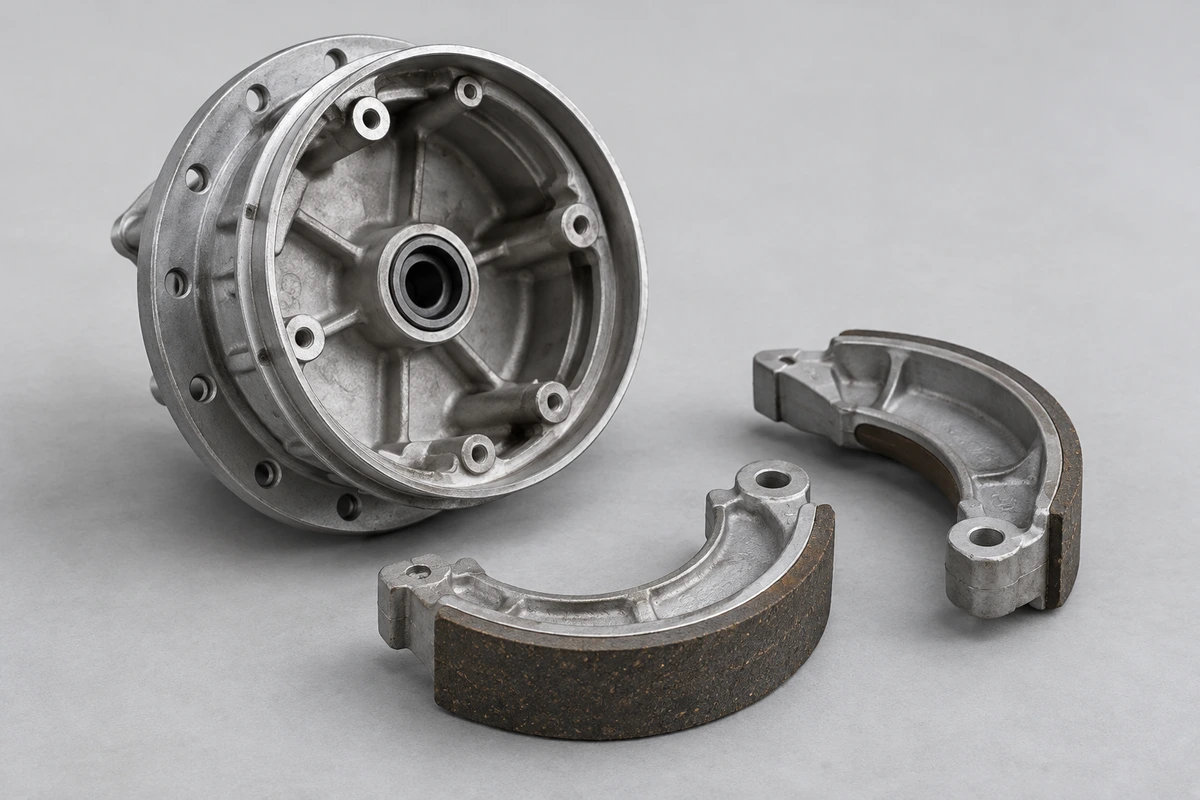
A returned drum and a returned pair of shoes can each be correctly identified while their service relationship remains unknown. For a brake-arcing handover, ask which shoe/backing-plate assembly the provider matched to which drum. Counting the returned items does not establish that relationship.
This review concerns an already authorized specialist service. It provides no machining method, brake adjustment, assembly sequence or permission to use a brake.
The service creates a relationship worth retaining
Race Tech's brake-arcing description connects its drum work to shoes mounted on their backing plate and matched to the resulting drum diameter. It also places wheel/spoke work before arcing in its stated service context. These observations were checked on 14 October 2026; they describe that provider's service, not another shop's capability or a universal acceptance specification. Race Tech brake-arcing service description
The purchasing implication is that a generic shoe part number may be insufficient after this service. Ask the actual provider to document the assembly association it created. Do not infer a match from common model fit, similar appearance or the fact that the parts returned in one carton.
Identify the pair at the service event
Use the provider's drum or wheel identifier and the associated backing-plate/shoe group. If the provider does not individually serialize components, ask what existing job references establish the association. A buyer can assign administrative references to the documents without claiming those labels existed during the work.
Keep the pre-service intake list and the post-service pairing declaration distinct. The intake proves only what the provider recorded receiving. The pairing declaration must identify the output relationship the provider says it produced. If an extra shoe set was included, require its own explicit association rather than assuming every shoe in the return is interchangeable with every drum.
A packing list can carry those references forward, but it cannot create the technical match. Where several jobs return together, request a provider-issued map before the goods are distributed onward. The receiver should not select a pair by the neatest fit in a box or by a photo of another completed job.
Ask whether later wheel work changes the evidence
Retain the wheel-work event that the provider says preceded arcing and any declared subsequent work. The source's sequence is relevant because it defines the state against which the matching service was described. Purchasing should not decide that later work invalidated the brake, but should ask the qualified provider whether its original association or conclusion still covers the changed state.
If a rim or spoke service occurs after the matching record, keep that event visible when forwarding the packet. A new delivery date does not reset the technical history. A provider may reaffirm its earlier scope or require another assessment; preserve the exact response without prescribing the method.
Matched-service record worksheet
| Field | Record required | Boundary to keep visible |
|---|---|---|
| Drum/wheel identity | Exact job reference and provider association | Not just the vehicle model |
| Shoe/backing-plate group | Identified group used in the service | Not a count of loose shoes |
| Matching declaration | Provider record tying that group to that drum | Intake and pack proximity are insufficient |
| Wheel-work state | Event preceding the matching work | Subsequent work listed separately |
| Extra shoe set | Its own declared drum association, if supplied | No assumed interchangeability |
| Changed-state response | Qualified disposition and remaining questions | No buyer-issued brake release |
The table is an original evidence aid, not a manufacturer inspection form or an instruction to mark, machine or manipulate parts.
Fictional case: two drums and two plausible groups
Suppose fictional jobs D-A and D-B return together with shoe/backing-plate groups S-A and S-B. The carton list accounts for both drums and both groups but does not identify the matching relationship. The seller suggests using whichever group looks most similar to each wheel.
The buyer asks for the service provider's pairing record. If that record identifies D-A/S-B and D-B/S-A, preserve the actual association even if the letter labels initially suggested otherwise. If the provider cannot establish the pairing, classify the relationship as unresolved and obtain its qualified next-action proposal. Correct quantities do not cure lost service identity.
A complete pairing record is still narrower than brake performance approval. It answers which components were matched under the stated service scope. Condition questions, later work and permission for installation or use retain their own responsible owners. This is also different from deciding where wheel assembly is purchased: the service location may be settled while the returned match remains undocumented.
Send a focused purchasing enquiry
See Motorcycle parts for category context. A Motoparts sourcing request can identify the actual product and the specific missing provider answer. Motoparts offers independent aftermarket and unbranded buying coordination and supplier negotiation. Manufacturer examples here imply no affiliation, branded-goods offer, specialist-service capability, fit guarantee or engineering approval.
The initial form accepts a supported marketplace HTTPS link, an 8–1200-character description or screenshots. Images are limited to five PNG, JPEG, WebP or GIF files, 10 MiB each and 20 MiB combined. PDF, CAD, ZIP and other technical files need a separately agreed authorized exchange; the image field is not a technical-file portal.
Frequently asked questions
Does a complete return packing list prove the shoes match the drum?
No. It accounts for items, while the matching record establishes a provider-declared service relationship. Request the exact drum-to-shoe/backing-plate association, especially when several jobs return together.
Can the same shoe part number establish post-arcing interchangeability?
Not by itself. Preserve the actual service pairing and ask the qualified provider to resolve any proposed reassignment. This article supplies no interchangeability rule or physical fit trial.
Why record wheel work performed after arcing?
The provider’s matching evidence concerns a particular service state. Disclose subsequent work and ask whether the original conclusion still covers it. Purchasing should neither ignore the event nor diagnose its effect.
What if the provider cannot recover the pairing record?
Keep the association unresolved and request a qualified disposition or separately authorized assessment proposal. Do not rebuild a technical match from carton position, administrative labels or appearance.
Sources
Discuss a sourcing request related to this article.Drum Brake Arcing Handover: Preserve the Matched Assembly