
Clutch Kit Packout: Do Not Pool Approved Plate Sets
Review a proposal to pool clutch plates by type against the original supplied sets. Keep set membership distinct from piece count and condition.
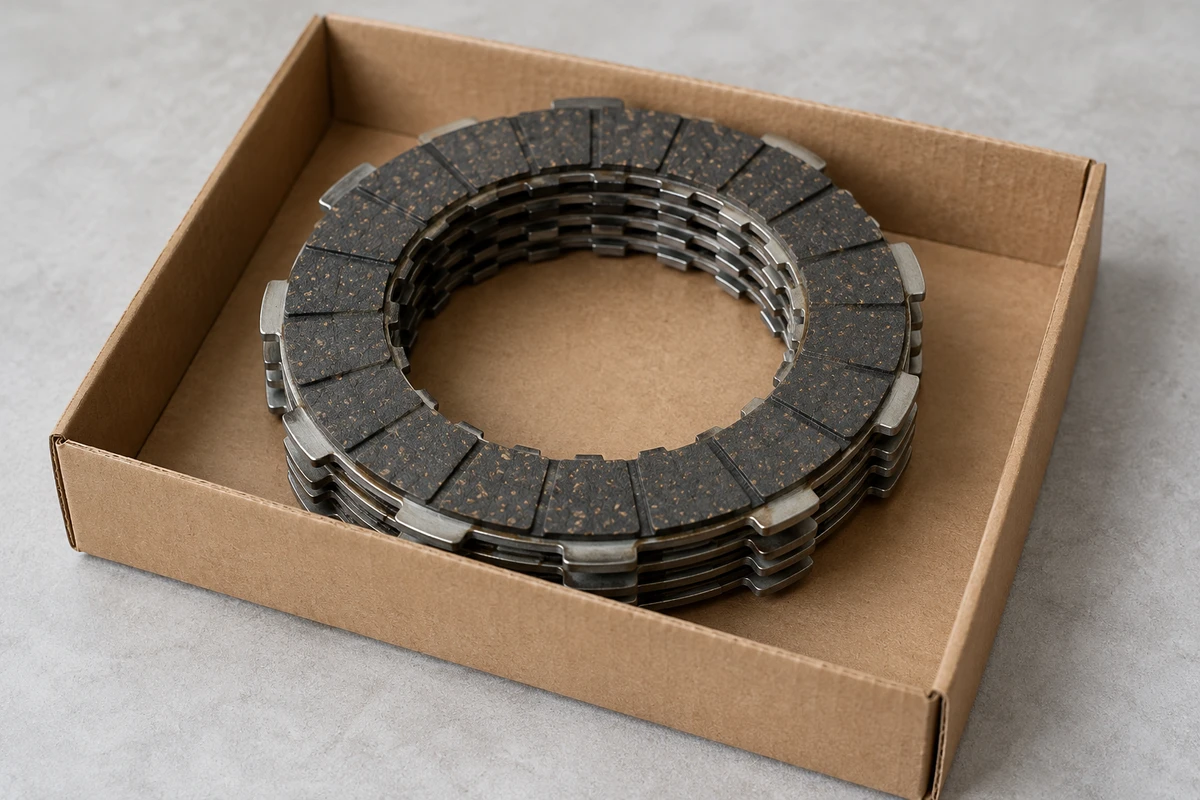
A packer can retain every friction plate, steel plate and spring in a shipment while losing the complete clutch sets the buyer purchased. That happens when separately supplied sets are emptied into type-based stacks and later rebuilt from the totals. Before approving a clutch set packout change, identify whether the proposal crosses an established set boundary.
This is a post-approval packing decision. The required rebuild scope, exact application and accepted kit should already be established. No plate measurement, stack calculation, wear assessment or installation sequence is provided here.
Use the supplied set as the baseline
EBC's DRC page describes friction plates, steel intermediate plates and springs, and a stack-height-controlled friction-plate set. These are bounded features of its named range, checked on 14 October 2026. They do not establish a plate count, tolerance or packaging arrangement for every clutch. EBC DRC clutch kits
Ask the actual provider how the accepted kit is supplied and which groups belong to it. Preserve any established set-level record. Do not assume that every component is individually serialized, or that all pieces must be technically matched in the same way. The packing record should retain the relationships the provider actually defines, without inventing additional ones.
Use kit issue and contents issue as separate references where needed. A later contents revision may alter the supplied group even if a short family name stays unchanged. The packer needs the issue approved for this order, not a remembered arrangement from an earlier shipment.
Distinguish outer consolidation from plate pooling
Combining intact supplied kits in a transport carton leaves their set boundaries available for review. Sorting their loose plates into one friction stack and one steel stack creates a different proposal: it requires a basis for restoring the purchased sets. Saving space does not provide that basis.
Ask the packing provider to mark every step that separates the original groups. Its response should state whether membership remains attributable throughout, which product-provider permission covers the change and how the final kits are identified. A photograph of tidy stacks addresses appearance, not those relationships.
Where the original set cannot remain intact under the proposed layout, request a revised outer arrangement or a specifically supported alternative. Do not instruct the packer to choose plates by apparent thickness, finish or sequence. Those choices would turn packaging work into unapproved product reconstruction.
Fictional example: correct totals after pooling
Imagine fictional kits K-1 and K-2, each accepted as a complete supplied set. A consolidation plan combines all friction plates in tray F, all steel plates in tray S and all springs in tray R. The final packing list proposes to divide each tray equally between two retail boxes. No real quantities or products are represented.
An equal division could preserve a total while failing to preserve the original memberships. The buyer asks for the actual authority and records supporting the regrouping. 'Same model' is not a substitute for that response where the agreed supply is two separately controlled sets.
Suppose the provider instead proposes retaining K-1 and K-2 in their documented supplied groups under a common outer carton. The buyer can review that scope without asserting a universal prohibition on all repacking. If pooling has already occurred, the record should say so and identify what evidence survives. It should not describe reconstructed boxes as original intact sets.
Record the affected groups without prescribing a stack
This is an original purchasing worksheet, not a technical standard or an instruction to handle the product.
| Review field | Record or request |
|---|---|
| Kit issue | Accepted supplied-set and contents revision |
| Friction group | Provider-defined group and its original set |
| Steel group | Included group or explicit exclusion |
| Spring group | Included group or explicit exclusion |
| Proposed pooling | Exact separation or reassignment in the new layout |
| Provider decision | Authority, surviving membership evidence and unresolved sets |
The group rows should reproduce the provider's supplied descriptions, not a new assembly order. If springs are excluded from the approved kit, record the exclusion rather than adding them because the documentary EBC example includes them. The exact purchased product controls.
Keep replacement requests separate from regrouping. A damaged-looking steel plate may require a condition assessment, but that does not authorize taking one from a neighboring kit. An accepted replacement must have its own documented scope and should update the affected set record.
Make the final pack declaration precise
Before releasing the revised packing instructions, compare the retained set records with the provider's declared final groups. Show any pooled or unresolved set separately. A packing acceptance should explain which membership was preserved and which change was authorized; 'all plates present' is too broad to close this decision.
The result is a traceable supplied-set handover. It does not prove a correct clutch stack, satisfactory plate condition or readiness to operate. Those technical questions remain with the responsible provider using the exact application and applicable evidence.
Bring the exact change into the sourcing request
See Dirt bike parts for product context. A Motoparts sourcing request should identify the accepted product, the proposed packing change and the unanswered decision above. Motoparts provides independent aftermarket and unbranded buying coordination and supplier negotiation. Named manufacturers are documentary examples, not branded-supply offers, affiliations or evidence of another provider's capability.
The initial form supports a supported-marketplace HTTPS link, an 8–1200-character description or screenshots. It accepts up to five PNG, JPEG, WebP or GIF images, at most 10 MiB each and 20 MiB combined. PDF, CAD and ZIP files require a separately agreed authorized exchange. The form is not a technical-file portal; a request does not establish engineering approval or a specialist packing service.
Frequently asked questions
Can friction and steel plates be pooled to save packing space?
Treat that as a change to the supplied-set arrangement, not a neutral carton change. Obtain the exact provider’s authority and a record showing how the approved sets remain attributable. A correct shipment total does not reconstruct set membership.
Does the EBC example establish the contents of every clutch kit?
No. It describes the named DRC range and its stated groups. Use the actual approved kit’s contents issue, including exclusions. Do not add springs, invent plate counts or transfer stack requirements from the example.
Can a plate from another kit replace a questionable one?
That is a separate product and condition decision. Keep the affected set and proposed replacement visible and obtain the appropriate provider disposition. The packing team should not borrow a similar-looking plate simply to complete a box.
What if plates were pooled before the review?
Record the actual changed state and the remaining traceability evidence. Ask the provider to resolve the supplied sets under an authorized scope. Newly numbered boxes should not be presented as evidence that the original memberships survived.
Sources
Discuss a sourcing request related to this article.Clutch Kit Packout: Do Not Pool Approved Plate Sets