
Universal Cable Packs: Describe the Supplied Loose Fitting
Keep an intentionally loose cable fitting visible in the packing description without presenting the supply as a finished ready-to-use assembly.
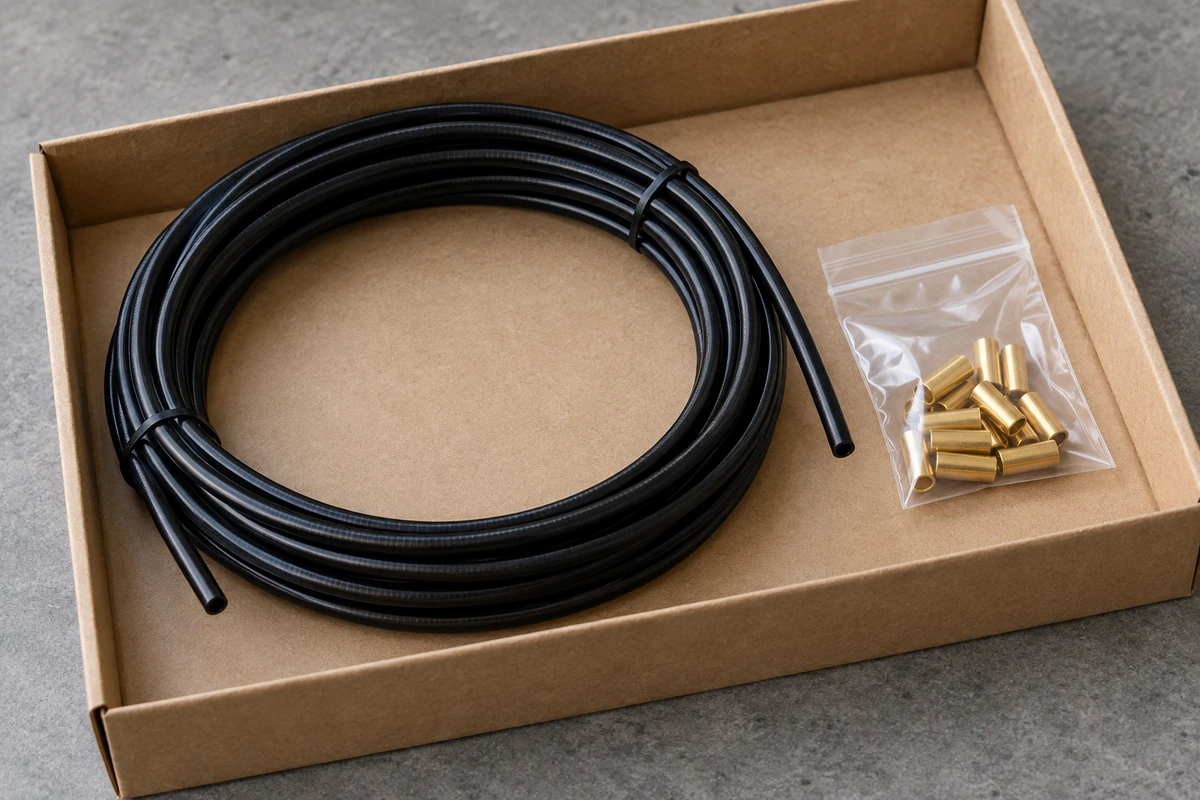
A universal cable can be supplied with a deliberately loose fitting. New packaging should preserve that declared state rather than hide it behind a finished-assembly title. Before approving the label, compare the provider's exact supply description with what the retail presentation would lead a buyer to expect.
This is a documentary supply-state decision. It gives no cutting, soldering, fastening, routing or fitting instructions. A loose fitting is not automatically a defect, and it is not automatically intended; its status must come from the accepted product record.
Read the actual line, not just universal cable
Motion Pro's universal-cable table distinguishes inner-wire-only entries from other cable descriptions. Its 01-0204 entry expressly describes a loose lower fitting. These observations were checked on 14 October 2026 and apply to those named descriptions only. They do not establish the supplied state of another cable or authorize completion work. Motion Pro universal cables
For the actual order, retain the complete accepted reference and description. Identify whether the purchase is inner wire, a cable with declared loose items or another documented supply. A broad category heading is not enough to settle that distinction.
If a separate fitting is observed but no document declares it loose, ask the provider to clarify the discrepancy. Do not copy the Motion Pro example into the order as an explanation. The source demonstrates that such supply states exist; it does not diagnose the buyer's delivery.
Keep the loose item visible in the presentation
Ask the layout owner where the declared loose fitting is represented and how it remains associated with the cable. A small packet may be appropriate under the provider's proposal, but the article does not prescribe its material or construction. The documentary requirement is that its presence and role are not lost.
Review terms such as assembled, complete and ready to use against the exact accepted state. Complete can mean all purchased items are present while still leaving a defined technical task outside the supplied assembly. If the word would mislead the intended recipient, request more precise wording from the product-information owner.
Avoid using the package photograph to stage a completed connection that is not actually supplied. Nor should the packer attach the fitting simply to make the product match the proposed image. That would be technical work outside a cosmetic packing change.
Fictional example: loose-ended supply becomes finished cable
Imagine fictional order C-41 explicitly accepts a cable with a loose lower fitting. A new card labels it 'finished replacement cable' and shows the loose fitting outside the photograph crop. The references and events are invented.
The buyer asks for a label that preserves the accepted supply state and a layout that accounts for the separate fitting. There is no need to determine how it should be attached. The mismatch is between the approved product description and the proposed recipient message.
Suppose the seller offers to finish the cable before dispatch. That is a new scope proposal requiring its own exact specification, appropriate technical responsibility and buyer approval. A packing reviewer should not accept it merely because it would make the original card accurate.
Alternatively, suppose the accepted order required a finished assembly and the seller now cites a universal-cable page to justify loose supply. The buyer should retain the actual order discrepancy. The existence of another loose-ended product does not amend this purchase.
Compare state, packet and wording together
This is an original purchasing worksheet, not a technical standard or an instruction to handle the product.
| Review field | Record or request |
|---|---|
| Approved reference | Exact accepted product line and description |
| Wire or complete cable | Provider-defined supplied object and exclusions |
| Declared loose fitting | Attributable statement that makes looseness intentional |
| Supplied packet | Location and association of the separate item |
| Finished-assembly wording | Title and image compared with actual state |
| Provider confirmation | Reconciled description or separately proposed completion scope |
Keep an intended loose item distinct from a missing, detached or damaged item. Those statuses require different provider answers. An existing packing view may show a separate fitting but cannot establish which status applies without the product record.
Likewise, a declared loose fitting does not answer any independent housing or end-condition concern. If one exists, preserve it separately rather than using the supplied-state explanation to close the whole receipt or packout review.
End with an accurate supplied-state description
The selected package should identify the actual supply, account for the loose fitting and avoid unearned readiness wording. It should not contain improvised instructions for completing the cable. Applicable technical work and final application suitability remain with the competent provider.
Carry that state into the final order and packing records. If the provider changes from loose-ended to finished supply, or vice versa, return the difference for an explicit scope decision. An unchanged cable family name should not conceal the changed deliverable.
Bring the exact change into the sourcing request
See Dirt bike parts for product context. A Motoparts sourcing request should identify the accepted product, the proposed packing change and the unanswered decision above. Motoparts provides independent aftermarket and unbranded buying coordination and supplier negotiation. Named manufacturers are documentary examples, not branded-supply offers, affiliations or evidence of another provider's capability.
The initial form supports a supported-marketplace HTTPS link, an 8–1200-character description or screenshots. It accepts up to five PNG, JPEG, WebP or GIF images, at most 10 MiB each and 20 MiB combined. PDF, CAD and ZIP files require a separately agreed authorized exchange. The form is not a technical-file portal; a request does not establish engineering approval or a specialist packing service.
Frequently asked questions
Is a loose cable fitting automatically a packing error?
No. Some named products expressly include a loose fitting, but the actual accepted reference must establish that state. If the order does not, ask the provider to reconcile the observed item rather than assuming the looseness is intentional.
Can all purchased pieces be present without a finished assembly?
Yes, when that is the documented supply scope. Keep contents completeness and assembly state distinct, and use recipient wording that accurately describes both. This does not establish readiness for use.
Can the packer attach the fitting to match the display image?
A presentation request does not authorize that technical work. Any proposed completion requires its own exact specification, responsible provider and approval. This article supplies no attachment method.
Does a loose-fitting declaration resolve cable damage concerns?
No. It addresses intended supply state only. A separate housing or fitting-condition observation needs its own response, and the original order requirement remains the comparison basis.
Sources
Discuss a sourcing request related to this article.Universal Cable Packs: Describe the Supplied Loose Fitting