
Handguard Packaging: Separate Hardware and Shell Scope
Check whether a combined handguard presentation contains the ordered hardware, guard shells or both. Compatibility wording alone cannot prove inclusion.
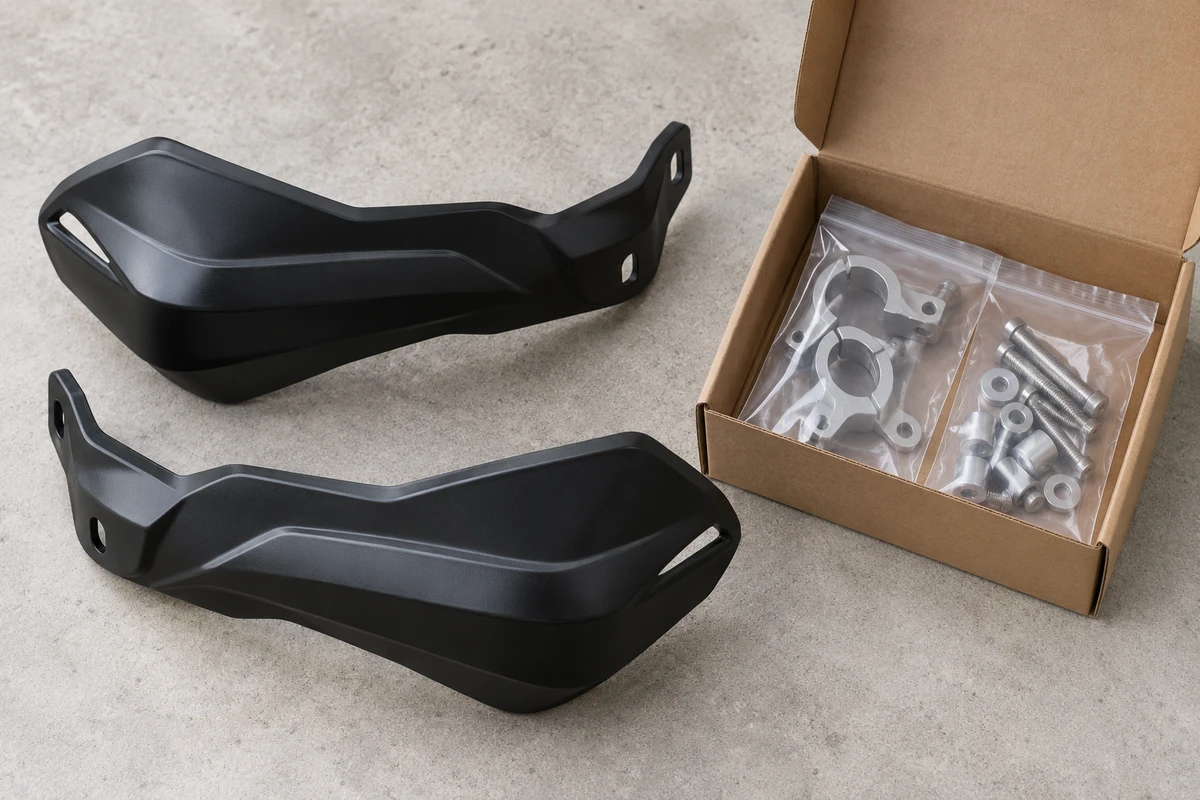
A handguard display can show mounting hardware and an outer guard shell together even when the purchase includes only one of them. Before approving a combined retail package, reconcile the presentation with the actual order lines. The buyer needs to know what is supplied, what is illustrated and what remains separately ordered.
This review begins after the exact hardware and any shells have been selected and approved. It does not choose a mounting kit, confirm motorcycle fit or assess protective performance. A clear combined label should describe the accepted commercial contents without expanding them.
Do not convert compatibility into inclusion
Barkbusters' bike-specific hardware page distinguishes hardware kits and compatible guard families. It also states that its recommended fitting options refer to motorcycles with OEM specifications. These bounded observations were checked on 14 October 2026. The compatibility language does not, by itself, prove that shells are included in any particular hardware offer. Barkbusters bike-specific hardware kits
Ask the actual provider to identify the accepted hardware kit code and the separate guard-shell order, if any. Use the final order confirmation rather than a styled photograph as the inclusion baseline. If a bundle genuinely contains both, obtain its attributable contents record; this article does not assume that every offer separates them.
Keep an explicit exclusion where appropriate. A hardware-only order is not short of a shell that was never purchased. Conversely, a new package title should not make the buyer believe that an ordered shell has become optional because the hardware has its own kit code.
Decide what the combined package represents
A combined presentation may be a new administrative bundle containing two purchased units. It may also be a hardware-only package with an illustration of a possible completed arrangement. These are materially different messages for the recipient.
Ask the artwork owner to map every pictured component group to included, excluded or illustrative status. Where the image shows an excluded item, obtain wording and presentation that make the actual scope clear without adding a fit or performance promise. The packing team should not resolve ambiguity by quietly adding unapproved goods.
Retain the original order references under any bundle name. A buyer's new bundle code can help manage the combined pack, but it should not be presented as a manufacturer's kit code. The recipient and purchasing records should still distinguish the hardware source unit from the shell source unit.
Fictional example: a complete-looking front panel
Imagine fictional order H-20 purchases hardware kit HW-A only. The proposed front panel shows HW-A with shell GS-B and says 'complete handguard package.' No shell line appears on the accepted order. The codes and proposal are invented.
The buyer asks for an accurate hardware-only presentation or a separately authorized purchase-scope change. It should not file a shortage claim for GS-B based solely on the mockup, nor accept the enlarged title as a promise that the provider will include it for free.
Now consider a second fictional order that does include both HW-A and GS-B. A combined package can account for both under their own references. If GS-B is deferred, that combined pack remains partial against the accepted bundle even when all hardware is present. Keep the missing shell visible instead of shortening the label back to hardware only after dispatch.
Use a two-source-unit contents record
This is an original purchasing worksheet, not a technical standard or an instruction to handle the product.
| Review field | Record or request |
|---|---|
| Hardware kit code | Actual accepted hardware unit |
| Guard-shell order | Separate reference, bundled inclusion or explicit exclusion |
| Confirmed inclusion | Provider contents record controlling the package |
| Two source units | Relationship between separately purchased units, if present |
| Combined label | Exact proposed wording and administrative bundle identity |
| Unordered items | Illustrated exclusions and unresolved scope changes |
Review the record with the proposed artwork and the actual package contents declaration. The declaration should identify which units were packed; the artwork should describe that same scope. A promotional image cannot supply concealed quantities, and a contents list cannot establish that the illustrated mounting arrangement is approved.
If the provider introduces another shell family during the discussion, stop treating that as an equivalent artwork choice. Ask for the separately required product decision and update the commercial scope only after it is authorized. Similar appearance does not settle the relationship to the accepted hardware.
Close inclusion before presentation approval
The final decision should state whether the package is hardware only, shell only or a documented combination of both. Keep intentional exclusions and partial supply distinct. The useful outcome is a buyer who can understand exactly what one purchased pack contains without mistaking a compatibility statement for an included product.
Any later change to the pictured shell, hardware code or bundle title should return to that same contents baseline. Physical protection and application approval remain separate responsibilities; a more accurate package title does not establish either.
Bring the exact change into the sourcing request
See Motorcycle parts for product context. A Motoparts sourcing request should identify the accepted product, the proposed packing change and the unanswered decision above. Motoparts provides independent aftermarket and unbranded buying coordination and supplier negotiation. Named manufacturers are documentary examples, not branded-supply offers, affiliations or evidence of another provider's capability.
The initial form supports a supported-marketplace HTTPS link, an 8–1200-character description or screenshots. It accepts up to five PNG, JPEG, WebP or GIF images, at most 10 MiB each and 20 MiB combined. PDF, CAD and ZIP files require a separately agreed authorized exchange. The form is not a technical-file portal; a request does not establish engineering approval or a specialist packing service.
Frequently asked questions
Does a compatible guard family listed with hardware mean shells are included?
No inclusion conclusion follows from compatibility language alone. Use the exact accepted offer and contents record. Ask the provider to state whether shells are included, separately ordered or excluded.
Can I create one bundle code for hardware and shells?
A clearly administrative bundle code can link two actually purchased units. Preserve both source references and their accepted contents beneath it. Do not represent the new code as a manufacturer kit designation.
Is a missing shell always a supplier shortage?
Only if the accepted order required that shell. Distinguish an excluded item shown in artwork from an included item that was omitted or deferred. The commercial record, rather than the illustration, establishes what was bought.
Does an accurate combined label confirm motorcycle fit?
No. It records purchased inclusion. The exact hardware, shell, motorcycle configuration and applicable evidence require their own technical approval; this article supplies no mounting or impact-performance conclusion.
Sources
Discuss a sourcing request related to this article.Handguard Packaging: Separate Hardware and Shell Scope