
Fork Service Kit RFQ: Map Bushings and Seals to Their Jobs
Map the approved fork-service positions to exact kit contents, keeping bushings, oil seals, dust seals and ancillary items separate.
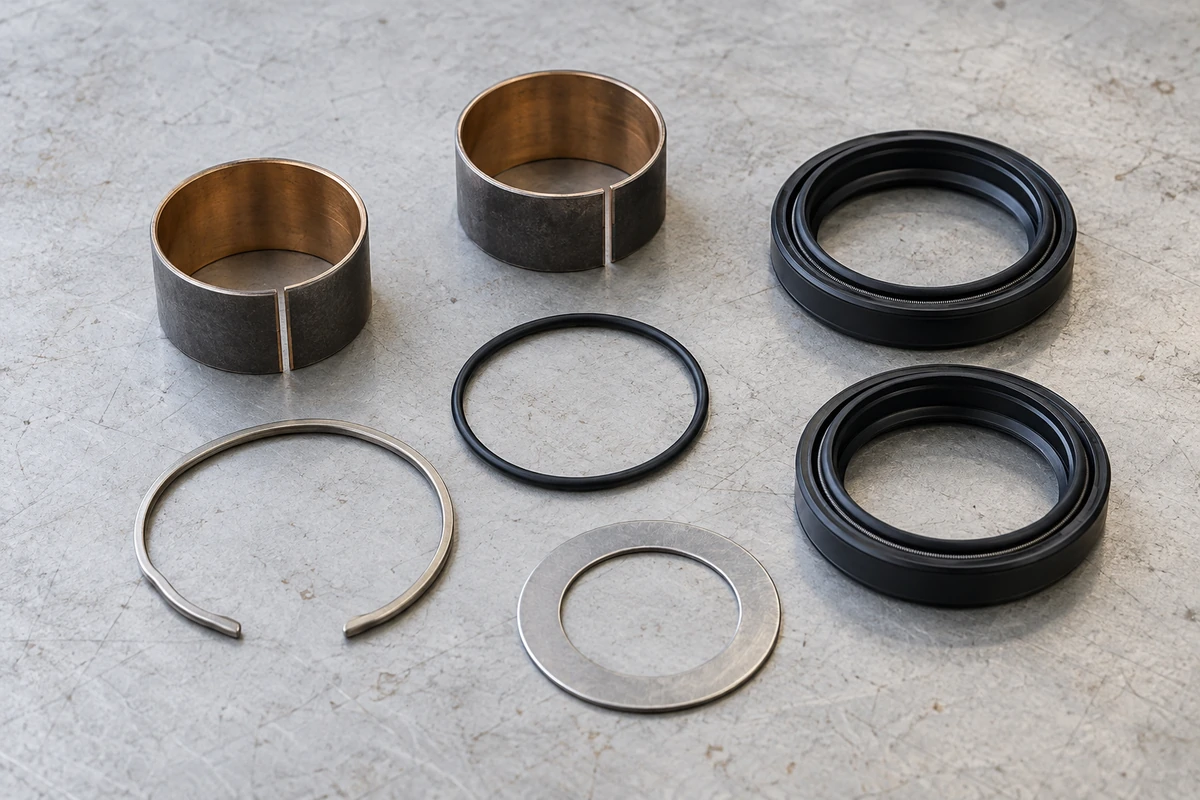
A fork service kit RFQ should show which approved service positions each quoted item is meant to address. A bushing package with an O-ring in its contents is not enough evidence that the required oil-seal or dust-seal position is covered.
Begin with the actual installed fork. If it has been replaced or modified, the motorcycle's original model record may identify the wrong assembly. Ask the responsible service provider to confirm the fork reference and the service scope before purchasing converts a catalogue title into a parts list.
Use a contents table without overreading it
The supplied source record, dated 14 October 2026, for All Balls kit 38-6176 records bushings, O-rings, snap rings and washers in its contents table, with no fork oil seals listed there. Its primary product page could not be reopened during authoring or independent review, so that observation is not a newly verified current bill of materials. Recheck the exact product record before relying on it for an order. All Balls 38-6176 product record
The example supports a question, not a universal rule about the maker's kits: which separately specified positions does this particular package answer? Do not extend an absent line in one observed table to every fork kit. Do not interpret an O-ring entry as an oil seal simply because both are sealing-related items.
For the actual quote, ask for a current exact-SKU contents record. A seller's generic photograph or range description should remain supporting material until its relationship to the offered item is established.
Map required positions before counting pieces
Give the approved bushing positions, oil-seal requirement and dust-seal requirement their own rows. Use the provider's terminology and source references. Retainers and washers should be identified independently where they belong in the approved job.
This is a function-and-position map, not a teardown plan. The buyer should not dismantle the fork to invent a missing component schedule. Request the relevant service or parts record and identify the person who can resolve ambiguous locations.
Keep supplied contents distinct from the complete service basket. A bushing-only offer may answer its intended scope perfectly while leaving the rest of the authorized job outside its price. That is useful information, provided the quotation makes the boundary clear. It does not mean the package is defective or that every seller must sell all groups together.
A fictional O-ring answer to an oil-seal question
Suppose a fictional service request specifies fork bushings and separately identified oil and dust seals. Offer A lists bushings and O-rings, then calls the package a complete fork kit. Offer B identifies the bushing package and states that the two sealing groups are outside its price.
A has an unresolved mapping: the O-ring listing does not identify the requested seal positions. Ask it to provide exact references for those positions or declare them excluded. B is clearer about scope, but the buyer still needs a quotation for the remaining required items and appropriate application evidence for the whole basket.
Neither response authorizes reuse of an unquoted seal. The technical provider's approved job remains the baseline. If a later reply supplies different quantities, resolve the actual positions and contents first rather than assuming that a higher count closes the service requirement.
Negotiate against a completed service map
Request actual pricing for the agreed groups, keeping each offered SKU traceable to its position. An affordable alternative must answer the same application and scope; an unexplained smaller basket is not a saving on the full job.
Ask the provider to confirm the exact fork application and any supplier-proposed differences. This RFQ does not diagnose leakage or wear and gives no dismantling, seal-fitting or suspension test instructions. Its value is a clear map of what the quotation covers and what remains unanswered.
A product-specific quotation worksheet
| Field | Record and request | Keep unresolved |
|---|---|---|
| Installed fork identity | Actual fork reference and replacement history | Original motorcycle model assumed to describe a changed fork |
| Bushing positions | Provider-approved positions and offered item references | Total bushing count used as position evidence |
| Oil-seal requirement | Exact required position and supplied/excluded answer | O-ring name substituted for oil-seal identity |
| Dust-seal requirement | Separate required scope and offered reference | Oil-seal answer assumed to include dust sealing |
| Retainers and washers | Approved ancillary list and actual kit contents | Generic complete-kit wording |
| Current BOM evidence | Exact SKU, current contents source and unresolved changes | Earlier observation presented as current stock confirmation |
Use this original purchasing worksheet to record the supplier’s actual answers. It is not a test procedure or fit certificate; unresolved safety-sensitive application questions require exact product evidence and confirmation by the responsible provider.
Prepare a sourcing request
Use the Dirt bike parts category for the product group and the Motoparts sourcing request for the exact item and unanswered question. Keep any affordable aftermarket or unbranded alternative tied to the authorized application or released drawing. Motoparts is an independent buying agent for aftermarket and unbranded parts; a request does not establish supplier manufacturing capability, guaranteed savings, branded affiliation or technical approval.
The initial form accepts a description of 8–1200 characters and up to five PNG, JPEG, WebP or GIF images, limited to 10 MiB each and 20 MiB total. Authorized drawing images may start a customization enquiry. CAD, PDF and ZIP files require a separately agreed authorized exchange; the image field is not a technical-file portal.
Frequently asked questions
Does an O-ring in a fork kit mean the oil seal is included?
No. Ask which exact required position the item serves and obtain the offered seal reference. A component name alone does not map it to the approved oil-seal requirement.
Can I select the kit solely from the motorcycle year?
Confirm the actual installed fork, especially after a replacement or modification. The original model record may not describe the current assembly.
Is a bushing-only package necessarily incomplete?
It may be complete for its stated bushing scope while excluding other parts in the service job. Record each boundary and ask separately for the required sealing groups.
Is the 38-6176 contents example a current verified order list?
No. It is a bounded prior primary-page observation whose current recheck failed during authoring and independent review. Obtain the current exact-SKU contents and application confirmation before using it for an actual purchase.
Sources
Discuss a sourcing request related to this article.Fork Service Kit RFQ: Map Bushings and Seals to Their Jobs