
Clutch Handover: Account for Judder Hardware Disposition
Reconcile returned auxiliary clutch hardware with the exact kit instructions and installer record before calling an omitted or loose item a shortage.
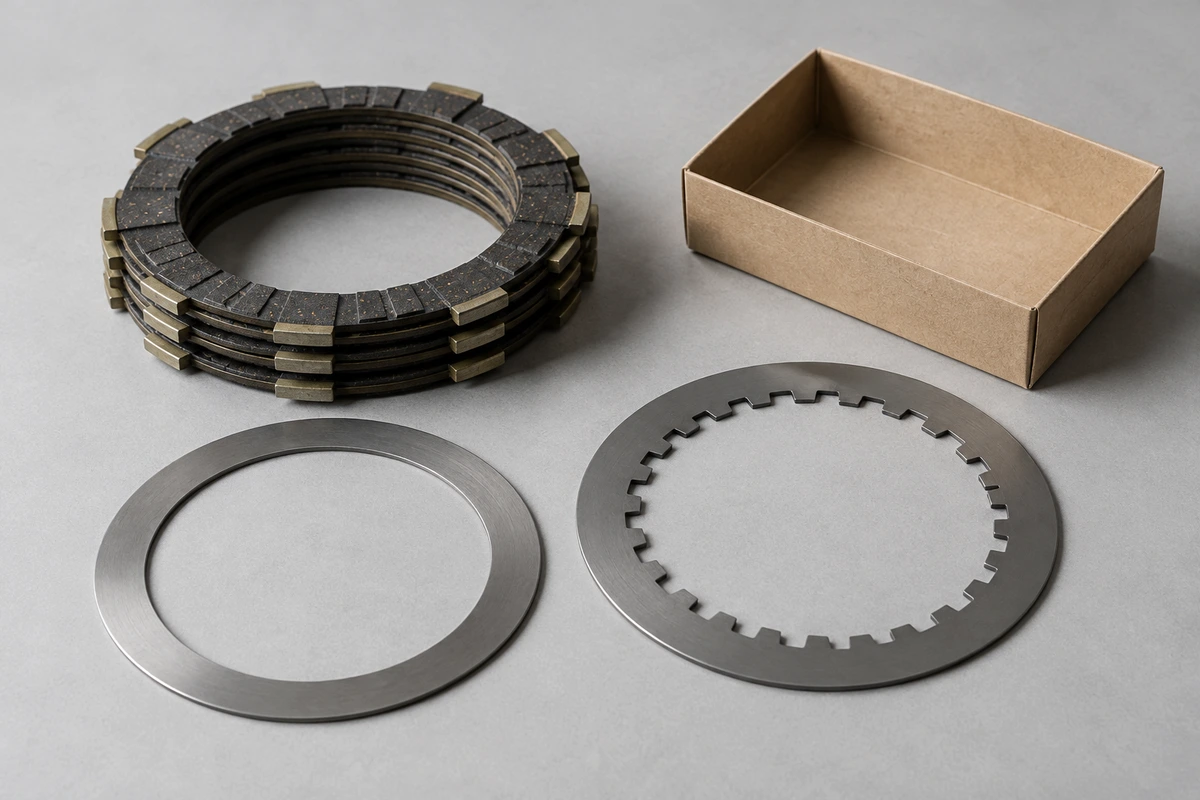
A loose washer or ring returned after clutch work can mean several things: an intentionally unused original, a supplied alternative, or an item whose disposition has not been explained. Do not order a replacement or mark the installation incomplete until the record identifies the part and the kit-specific decision.
The handover begins after the replacement kit and service scope have been approved. It does not choose plate thicknesses, decide whether a spring is reusable or explain how to assemble a clutch.
Auxiliary hardware does not have one universal rule
Barnett's new-clutch guidance identifies examples including judder springs, clutch boss rings, rubber O-rings and wave washers. For its products, whether such items are disregarded depends on the particular kit instructions. That bounded statement was rechecked on 14 October 2026. It is not permission to omit any named part from an unknown clutch. Barnett new-clutch guidance
Use the actual kit reference and instruction issue. A range name, a generic complete-kit claim or another owner's installation account cannot decide the disposition in this job. If the applicable instruction is missing, preserve that dependency rather than interpreting loose returned hardware as an answer.
Build the record around roles, not a leftover bag
Ask the installer to identify the auxiliary items relevant to the job and state each one's documented disposition. Distinguish retained in the completed assembly, omitted under the applicable instruction, replaced by an identified item, and unresolved. These are documentary statuses; purchasing is not selecting them on the installer's behalf.
Record custody separately. An original ring may be omitted from the assembled configuration but still belong to the owner and be returned. An item that remains installed will not also appear in the return bag. Conversely, an unexplained absence from the bag does not prove installation. The work record must make the relationship clear.
Where the provider uses a different term, request a mapping to its parts or instruction reference. Do not equate every thin ring with a wave washer, or every spring-related component with a judder spring. Existing photographs can support identification, but the provider must establish which item its decision covers.
Reconcile exceptions before creating another purchase line
Read the approved kit instruction and the installer statement together. If the statement says omitted but cites a different kit issue, ask for reconciliation. If it says retained but the same identified item is recorded in the returned-property bag, ask the author to explain whether there were multiple items or an identification error.
A contradiction is an evidence question, not proof of improper work. Request a corrected, attributable record and any qualified disposition needed. Do not direct a workshop to reinstall a leftover item just to make a familiar inventory complete.
Only after the responsible owner identifies an actual missing supply should purchasing seek a defined replacement. A premature order may duplicate a part that the kit intentionally does not use, while making the record look resolved without answering what was installed.
Auxiliary-hardware disposition worksheet
| Record | Entry to obtain | Keep separate |
|---|---|---|
| Approved kit | Exact application, kit identity and issue | General family description |
| Applicable instruction | Specific source and relevant hardware passage | Another kit's rule |
| Auxiliary item | Provider identity and original role | Visual nickname |
| As-built disposition | Retained, omitted, replaced or unresolved, as declared | Physical custody after work |
| Returned property | Actual item and custody reference | Assumption that every return is a defect |
| Reconciliation | Installer explanation and technical owner's bounded response | New purchase authorization |
This is an editorial purchasing record, not an installation checklist or a stack-height specification.
Fictional case: a returned ring triggers a duplicate order
In a fictional job, kit K is installed and a labelled original ring is returned to the owner. A clerk treats the ring as evidence that a required new part was missing and starts another order. The installer then explains that its kit-specific instruction addresses that item, but supplies no instruction issue or attributable work entry.
The buyer pauses the unsupported shortage conclusion and asks for those two records. If the applicable issue and completed-work declaration explain the disposition, the return can be recorded accurately without inventing a missing part. If they conflict, the technical question remains open even if the supplier offers a free replacement.
The goal is a coherent account of the completed clutch's auxiliary hardware. It neither revisits the earlier friction/steel/spring quotation boundary nor proves that an assembled clutch performs correctly. A correct return-property inventory and a clear installed-state record are complementary deliverables, not interchangeable ones.
Send a focused purchasing enquiry
See Motorcycle parts for category context. A Motoparts sourcing request can identify the actual product and the specific missing provider answer. Motoparts offers independent aftermarket and unbranded buying coordination and supplier negotiation. Manufacturer examples here imply no affiliation, branded-goods offer, specialist-service capability, fit guarantee or engineering approval.
The initial form accepts a supported marketplace HTTPS link, an 8–1200-character description or screenshots. Images are limited to five PNG, JPEG, WebP or GIF files, 10 MiB each and 20 MiB combined. PDF, CAD, ZIP and other technical files need a separately agreed authorized exchange; the image field is not a technical-file portal.
Frequently asked questions
Does returned judder hardware mean the installer forgot it?
Not necessarily. Ask for the exact item identity, kit instruction and installer-declared disposition. Returned custody alone does not show whether an item was required in the completed configuration.
Can Barnett’s general guidance authorize omission from another kit?
No. The cited guidance points back to the particular kit’s instructions. Another maker or application needs its own applicable evidence, and purchasing cannot infer omission from a generic kit name.
Should every unused ring be ordered again as a missing part?
First establish why it is unused and what the actual kit requires. A new order does not explain the completed assembly. Seek a replacement only against a responsible owner’s defined missing-supply requirement.
What if the work record says installed but the item is in the return bag?
Ask the installer to reconcile the identities and records. There may be multiple items or an error, but neither should be assumed. Retain both records and obtain the qualified disposition without directing physical correction.
Sources
Discuss a sourcing request related to this article.Clutch Handover: Account for Judder Hardware Disposition