
Motorcycle Rotor Receipt: Identify the Surface Zone
Check whether a supplier’s finish explanation applies to the rotor hub or braking ring before closing a delivered surface concern.
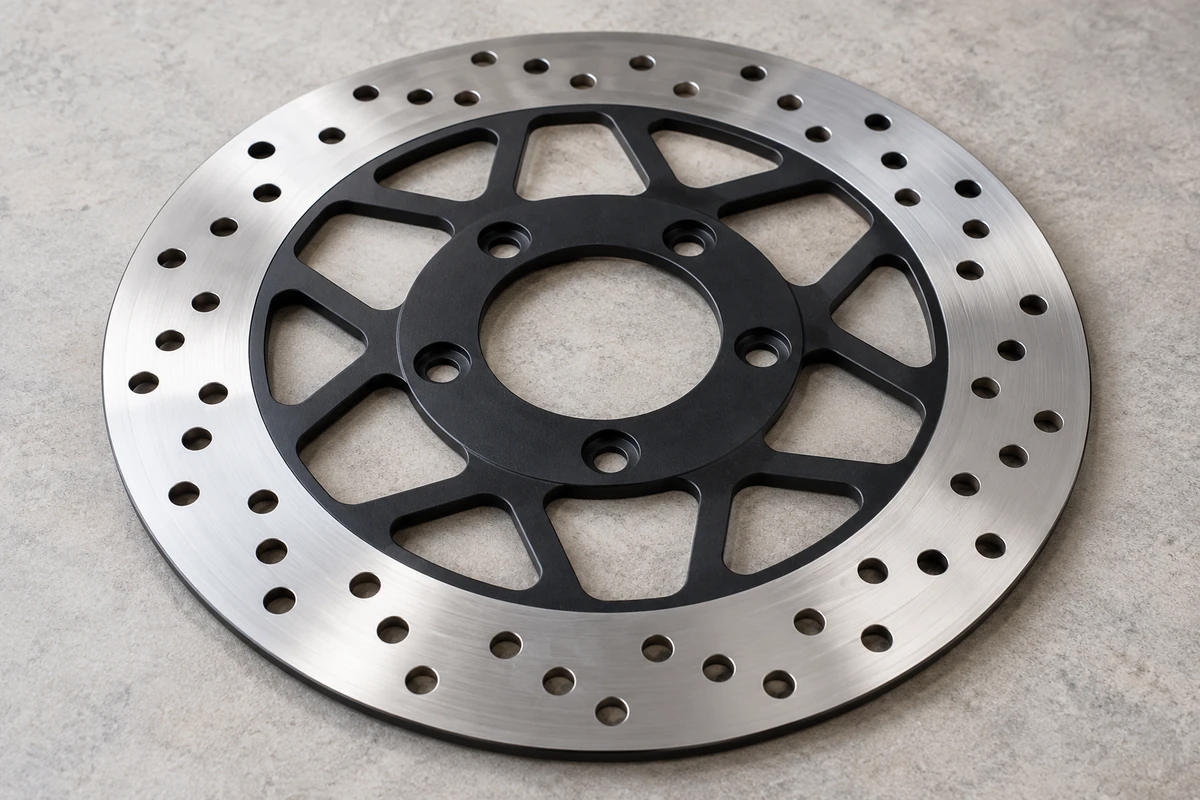
A supplier’s explanation of a decorative rotor-hub finish does not automatically explain a feature on the outer braking ring. Locate the reported surface concern first, then ask for the construction reference covering that zone of the exact delivered rotor.
This receipt guide separates surface-zone evidence. It does not assess button movement, define brake-disc geometry, match a decorative color or prescribe cleaning, refinishing or a braking test.
Name the zone before naming the problem
Keep a whole-rotor view linked to the existing detail image. Identify whether the reported feature lies on the center hub, outer ring, connecting region or another documented feature of the actual design. Use the product’s own drawing or description where available rather than assuming every rotor divides into identical zones.
Record which face and location the evidence shows. A close-up without orientation may prompt an answer about the wrong surface. If the location cannot be established, leave it unresolved and ask for clarification using available records; do not invent a zone from an ambiguous crop.
Describe the visible feature without assuming its composition or purpose. A dark patch, a ground-looking region or a differing surface appearance is not by itself evidence of a particular coating, contamination or manufacturing defect.
Read EBC’s construction description narrowly
EBC’s Black Chrome Rotors for Big Twins page describes decorative black chrome on the stainless center hub and a diamond-ground stainless outer ring. This is a two-zone construction example for the named range. It does not establish finish allowances for another product or permit an unexplained layer on a braking surface. EBC black-chrome rotor construction
The useful inference is that a finish description has a location. Do not copy the named product’s fit claims, braking guarantees or installation guidance to an independent aftermarket rotor. Ask the actual supplier for the applicable construction record instead.
Match each supplier statement to its surface
Retain separate references for the hub finish and outer-ring surface where the design distinguishes them. A product title such as “black rotor” may be too broad to explain what was actually specified. Ask the supplier to identify which areas receive the declared finish and which product revision defines that scope.
If the order used an approved drawing or sample record, keep that baseline beside the delivered observation. Do not use a different model’s catalogue image to fill an undocumented zone. If the original order lacked a usable surface description, record the gap rather than inventing an acceptance tolerance.
A supplier’s statement about cosmetic appearance can be accurate for the hub while irrelevant to the outer ring. Map the response explicitly to the identified concern. Do not shorten “hub finish confirmed” to “rotor finish accepted” when another surface remains unexplained.
Buyer worksheet
Use one record per identified unit or clearly defined affected group. This is an original purchasing aid, not a test procedure or acceptance standard.
| Field | Record to preserve | Question that remains open |
|---|---|---|
| Rotor identity | Full order and delivered designation with unit association | Another model used as the surface baseline |
| Hub finish reference | Applicable hub-zone description and controlling revision | Broad black-rotor label used for every surface |
| Braking-ring reference | Exact outer-ring construction evidence where applicable | Decorative hub statement applied to the ring |
| Observed zone | Whole view, face, detail location and literal appearance | Ambiguous crop or assumed chemical identity |
| Declared revision | Supplier change record and actual order authorization | Post-delivery document silently replacing the baseline |
| Unresolved surface | Zone-specific question, assessment owner and response scope | Cosmetic credit or another rotor check treated as clearance |
Preserve the surface while seeking an answer
Do not scrape, sand, polish, remove a layer or apply a chemical to determine whether a mark disappears. Do not mount the rotor and use braking to wear away an unexplained feature. This article provides no treatment or performance-test procedure.
Keep any known prior intervention in the chronology. If the supplier says it refinished or cleaned the unit before dispatch, request the actual declaration and the applicable authorization. A changed appearance after treatment must not replace the original received-condition record.
Where further examination is needed, ask the appropriate competent provider to define its scope for the exact product. The purchasing worksheet should identify the missing evidence, not attempt to supply a brake-surface acceptance method.
Fictional example: the right explanation for the wrong surface
Imagine fictional rotor D-25 whose order distinguishes a decorative hub finish from the specified outer-ring surface. An existing receipt detail shows an unexplained dark patch on the outer ring. The seller replies that the black hub finish is intentional. These are invented facts, not a diagnosis or a real product complaint.
The buyer records the hub explanation as background and asks for a response to D-25’s identified outer-ring zone. It does not infer that all dark areas belong to the same process. If the supplier claims a production revision changed the ring surface, request that revision and its authorization for the order.
A later document may resolve the intended construction while leaving the actual patch’s condition unassessed. Keep those outcomes separate. If replacement is proposed, obtain the exact replacement identity and review its own surface evidence against the applicable requirement.
Keep this receipt decision distinct
A resolved finish-zone question does not establish the condition of the rotor joints, its geometry, runout or braking performance. Those subjects require their own applicable evidence and responsible assessment. Likewise, a satisfactory response about another feature cannot answer the unexplained surface merely because it concerns the same rotor.
The final receipt record should name the zone, the controlling reference, the observation and the actual assessment. Record commercial remedies alongside that evidence without converting a credit into a technical conclusion.
The value of this approach is precision: a supplier must explain the surface the buyer actually reported, using the correct product construction. A broad finish label can then no longer hide the unanswered question.
Keep the request tied to the received item
Use the Motorcycle parts category for product context and the Motoparts sourcing request for the exact received reference and unresolved supplier question. Motoparts provides independent aftermarket and unbranded buying coordination and supplier negotiation. The manufacturer example above is documentary evidence, not a branded-goods offer, affiliation, inspection-service promise or engineering approval.
The sourcing form supports a supported-marketplace HTTPS link, an 8–1200-character description, or one or more screenshots. Image limits are five PNG, JPEG, WebP or GIF files, 10 MiB per file and 20 MiB combined. It does not accept PDF, CAD or ZIP uploads. Arrange other technical files only through a separately agreed, authorized exchange.
Frequently asked questions
Does a black rotor description mean every surface has the same finish?
No such assumption is supported. Establish the exact product’s surface-zone description. The EBC example distinguishes decorative hub finish from the outer braking ring, but another rotor needs its own construction evidence.
Can a hub-finish explanation clear a mark on the braking ring?
Only an applicable response to that actual ring concern can resolve it. Record the hub explanation at its stated scope and keep the outer-ring observation open until addressed.
Should I remove a patch or bed in the rotor to see what remains?
No treatment or braking test is authorized here. Preserve the received surface and request an appropriate product-specific assessment. Do not alter the evidence to make a supplier explanation appear correct.
What if the supplier says the surface changed in a new revision?
Request the exact revision, the affected product and the authorization for this order. Distinguish intended construction from the condition of the delivered zone; a later revision does not automatically resolve both.
Sources
Discuss a sourcing request related to this article.Motorcycle Rotor Receipt: Identify the Surface Zone