
Used CVT Belt Handover: Preserve Prior Running Direction
Retain an attributable prior-direction record for a removed belt without confusing wear history with an inherently directional product design.
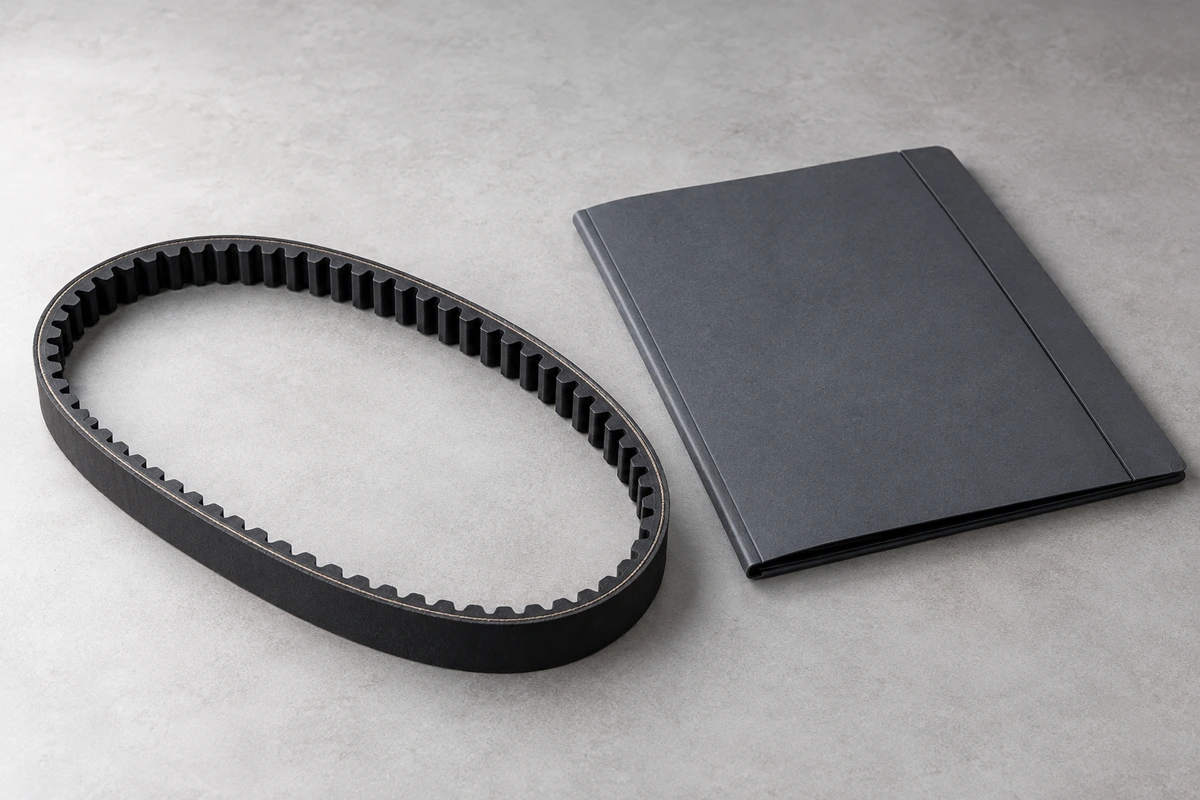
A removed CVT belt returned for possible later service needs an honest history record. If its prior running direction was documented, keep that association with the identified belt and machine. If it was not documented, a newly added arrow cannot reconstruct it.
This is a custody and evidence decision for a used item, not approval to reuse it. It provides no belt installation, marking, cleaning, break-in or riding instructions.
Distinguish construction from service history
Gates' G-Force bulletin TT004-13 says the covered belts are not directionally biased, while separately discussing retention of prior orientation for a belt removed and reinstalled in later maintenance to preserve the wear-profile relationship. The document bears a 2018–2020 copyright range and was rechecked on 14 October 2026. Gates powersports bulletin, page 2
Those statements answer different questions. A construction description does not erase a used belt's history. Conversely, a historical direction record does not establish that an otherwise unspecified belt is inherently directional. Ask the actual maker or qualified provider to establish current applicability for the exact product before any reuse decision.
Carry the history that existed at removal
Request the removed belt's identity, machine association and service-event reference. Ask what existing record establishes its prior orientation: an attributable job note, a documented label or an image whose viewpoint and meaning the provider can explain. Preserve the original evidence rather than turning a shorthand arrow into a new unsupported technical statement.
Keep the meaning of direction explicit. An arrow in a loose-item photograph is ambiguous without the provider's reference frame and association to the former installation. The buyer should ask the author to explain that reference using existing evidence, not reposition the belt or recreate a running condition.
If several same-reference belts were removed, preserve each item's association or the limits of any group record. A correct part number identifies a product type; it may not distinguish two used items with different histories. Do not distribute identical-looking returns to different machines on that basis alone.
Do not backfill history from a convenient feature
Readable lettering may identify a viewing orientation, but it is not an independent record of how an unknown custodian previously installed the belt. A fresh label applied after receipt should be described as a new administrative label, with its evidence basis or uncertainty.
Likewise, a provider's general preferred convention is not proof that a particular earlier job followed it. Request an event-specific statement. Where the provider cannot establish the earlier state, record “prior direction unknown” and send the question to the qualified owner without proposing a trial run.
The belt's condition and reuse disposition require separate evidence. Complete direction history does not answer age, wear, prior damage or suitability for another drive. A belt can be well documented and still lack reuse authorization.
Used-belt association worksheet
| Field | Entry to obtain | False inference to avoid |
|---|---|---|
| Removed belt | Exact part and distinguishable item reference | Same SKU means same used item |
| Former installation | Machine and provider-declared location | Any similar drive is equivalent |
| Removal event | Attributable job and event date | Return-shipping date as service date |
| Prior-direction evidence | Original reference with author explanation | New arrow as recovered history |
| Reference meaning | Provider-declared viewpoint and direction association | Lettering alone proves prior use |
| Reuse disposition | Separate qualified decision or explicit pending state | History complete means fit for reuse |
This editorial worksheet asks for records only. It does not direct physical handling or establish an acceptance standard.
Fictional case: two identical belts, one history note
A fictional workshop returns belts U-A and U-B with the same product designation. One removal note identifies a prior orientation but does not say which belt it covers. The seller proposes copying that note to both items because they look alike.
The buyer asks the workshop to recover the item association. If the provider can identify U-A from an existing job record, only U-A gains that evidence. U-B remains unresolved. If the association cannot be recovered, both records should state the limitation rather than gaining two invented histories.
The next custodian receives the actual evidence and the qualified owner's reuse status. This handover does not substitute for arrival fold-history assessment or a break-in completion record. Those concern different events; neither can tell the recipient which direction this particular used belt previously ran.
Send a focused purchasing enquiry
See Motorcycle parts for category context. A Motoparts sourcing request can identify the actual product and the specific missing provider answer. Motoparts offers independent aftermarket and unbranded buying coordination and supplier negotiation. Manufacturer examples here imply no affiliation, branded-goods offer, specialist-service capability, fit guarantee or engineering approval.
The initial form accepts a supported marketplace HTTPS link, an 8–1200-character description or screenshots. Images are limited to five PNG, JPEG, WebP or GIF files, 10 MiB each and 20 MiB combined. PDF, CAD, ZIP and other technical files need a separately agreed authorized exchange; the image field is not a technical-file portal.
Frequently asked questions
Does a prior-direction note mean the belt is inherently directional?
No. In the cited G-Force example, construction and wear-history guidance are separate. Preserve the exact source scope and ask the actual provider about the product; do not turn a service-history note into a universal design claim.
Can a new arrow recover an undocumented running direction?
No. It can express an administrative label or a provider-supported interpretation, but its evidence basis must be stated. A mark added later cannot by itself prove an earlier installed state.
Can one removal note cover two belts with the same part number?
Only if the attributable record explicitly establishes that coverage. Otherwise request the item association and keep the remaining history unknown. Product identity alone does not distinguish used-item histories.
Does complete direction history authorize reuse?
No. The qualified owner must separately establish condition, applicability and any permitted next step. This article supplies no reuse test, installation method or break-in procedure.
Sources
Discuss a sourcing request related to this article.Used CVT Belt Handover: Preserve Prior Running Direction