
Front Sprocket RFQ: Keep Tooth Options and Conversion Notes
Preserve the full front-sprocket reference, tooth-specific application row and any chain-conversion qualification when comparing offers.
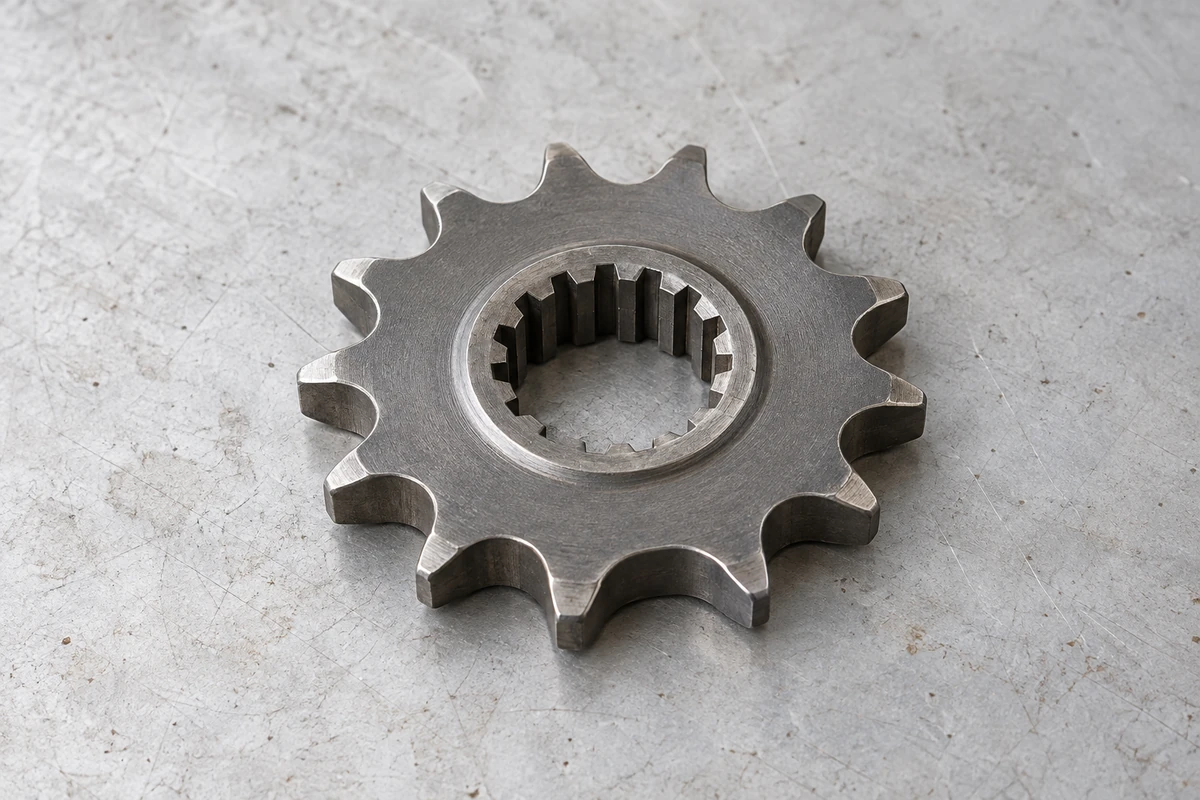
A front sprocket quotation can look like a direct replacement while relying on a catalogue row that assumes a chain conversion. Preserve that qualification from the first enquiry through the final quote. The buyer's task is to obtain an offer for the authorized configuration, not to recommend a new ratio or transmission conversion.
When requesting a front sprocket quote, start with the full part code, requested tooth option and actual chain configuration approved by the responsible provider. A motorcycle model appearing somewhere on a product page is not enough if the relevant row has conditions.
Read the application row with its heading
JT Sprockets' JTF513 entry lists multiple tooth options, points to JTF513RB as a rubber-cushioned alternative, and includes application rows marked for a 530 chain conversion. These are features of that named catalogue record. They do not recommend converting another motorcycle or establish the geometry of an unknown sprocket. JT JTF513 catalogue
Preserve three pieces of information together: the product designation, the tooth-count heading under which the vehicle appears, and the complete application-row note. A screenshot cropped to the vehicle name may lose the condition that explains the listing. Ask the supplier for the applicable row or document rather than accepting a bare statement that the model is listed.
Establish which configuration the buyer is retaining
The approved chain specification belongs in the request independently of the proposed sprocket. Identify the current service record and any previously authorized conversion. If the motorcycle's current configuration is uncertain, refer it to the service provider before treating either the original specification or a seller's preferred conversion as the baseline.
Keep a cushioned variant's full suffix visible. An alternative code on a manufacturer's page is a reason to investigate the exact option, not permission to erase its distinction. Do not infer a noise result, service life or suitability from the word cushioned. Ask whether the offered variant answers the actual requirement.
A drawing-based proposal must likewise preserve the released reference and required interfaces. Do not copy an unseen bore, spline or offset from a nearby catalogue family. The authorizing technical record, rather than an approximate image, must define those fields.
A fictional quotation with a hidden condition
Suppose a fictional buyer requests an unchanged replacement. Offer A quotes a tooth option against a row that explicitly assumes a chain conversion, but omits that note from its quotation. Offer B repeats the base part code while leaving the cushioned suffix unresolved.
A needs a configuration answer: is there a documented candidate for the buyer's existing approved chain arrangement? If not, classify A as a changed proposal. Do not treat the omission as a harmless abbreviation. B needs an identity answer: which exact variant is included in its price? Neither response establishes fit merely by including a familiar catalogue code.
The next message should be precise: 'Please quote the stated tooth option for the documented unchanged configuration, retain every application qualification, and identify the complete offered code including any variant suffix. Show any conversion-dependent offer separately.' This is an example request, not evidence that a supplier has accepted it.
Keep a conversion outside ordinary price negotiation
Quantity, packaging and supplier terms can be negotiated after the proposed object is clear. A lower price based on different chain requirements is not yet a saving on the requested replacement. It introduces a decision the buyer has not authorized.
Ask the responsible technical provider to confirm the exact application and required evidence before purchase. This comparison does not prescribe gearing, chain conversion, machining, installation or a road test. The completed record should preserve the catalogue qualification just as carefully as it preserves the price.
A product-specific quotation worksheet
| Field | Record and request | Keep unresolved |
|---|---|---|
| Full sprocket code | Base designation and every offered suffix | Variant shortened to a family name |
| Tooth option | Requested option and exact application-row heading | Vehicle name detached from tooth count |
| Application qualification | Complete conversion or other limitation | Condition cropped out of the quote |
| Chain specification | Authorized current configuration and source | Original specification assumed after modifications |
| Cushioned variant | Required and offered variant identified separately | Cushioned wording treated as a performance guarantee |
| Configuration disposition | Unchanged candidate or separately reviewed change | Conversion hidden inside a discounted offer |
Use this original purchasing worksheet to record the supplier’s actual answers. It is not a test procedure or fit certificate; unresolved safety-sensitive application questions require exact product evidence and confirmation by the responsible provider.
Prepare a sourcing request
Use the Motorcycle parts category for the product group and the Motoparts sourcing request for the exact item and unanswered question. Keep any affordable aftermarket or unbranded alternative tied to the authorized application or released drawing. Motoparts is an independent buying agent for aftermarket and unbranded parts; a request does not establish supplier manufacturing capability, guaranteed savings, branded affiliation or technical approval.
The initial form accepts a description of 8–1200 characters and up to five PNG, JPEG, WebP or GIF images, limited to 10 MiB each and 20 MiB total. Authorized drawing images may start a customization enquiry. CAD, PDF and ZIP files require a separately agreed authorized exchange; the image field is not a technical-file portal.
Frequently asked questions
Why keep a chain-conversion note in a sprocket RFQ?
It qualifies the application claim. A listing that assumes a conversion does not by itself answer a request to preserve the existing configuration. Ask for an unchanged-configuration candidate or classify the offer separately.
Does the vehicle name anywhere on the page establish fit?
No. Retain its tooth-count heading, full variant and application notes. Those details define what the catalogue actually says, while the actual vehicle still needs appropriate application confirmation.
Can I omit a rubber-cushioned suffix to simplify the quote?
Keep the complete offered designation. Ask whether that variant is required and supplied; a shortened code can conceal a different proposal. The suffix alone is not evidence of a particular performance outcome.
Can the supplier choose a different tooth count to lower the price?
That is a configuration change requiring separate authorization and technical consideration. Request pricing for the approved tooth option first; this buying guide does not recommend a gearing change.
Sources
Discuss a sourcing request related to this article.Front Sprocket RFQ: Keep Tooth Options and Conversion Notes