
Throttle Body Handover: Preserve the TPS Reference Lineage
Connect the provider’s pre-work TPS reference to its post-work restoration record without turning a historical reading into a universal sensor setting.
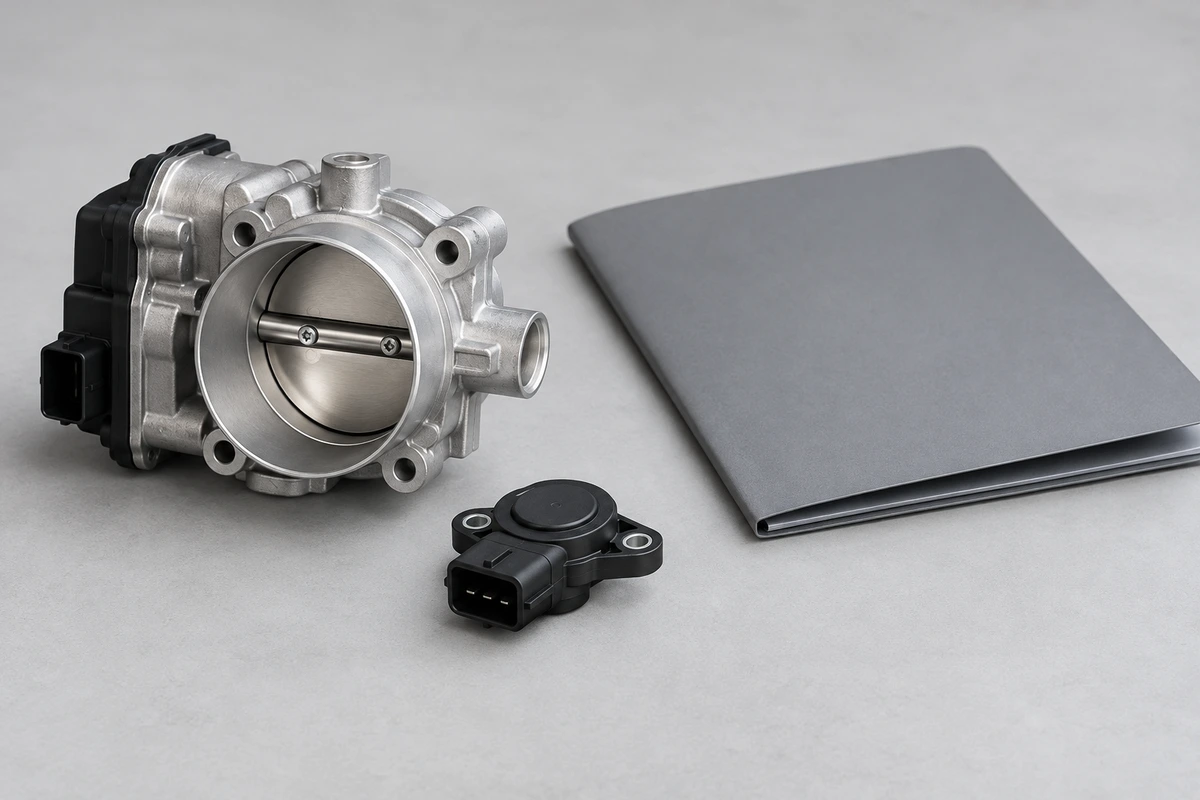
A post-service TPS entry can be neatly recorded while its relationship to the pre-work reference is missing. Ask the provider to connect the two records for the same throttle body, sensor and authorized service event. A standalone final number is not a reconstruction of the original reference.
This handover concerns reference lineage. It does not measure a sensor, supply a target, explain an electrical connection or instruct the reader to restore a setting.
The historical source describes a before-and-after relationship
Twin Air's historical Powerflow configuration 1 instructions call for a pre-work TPS reference to be recorded and later used during restoration. The document also contains application-specific qualifications, which must remain with the applicable instruction. Its PDF was reopened on 14 October 2026; the filename carries 14 October 2014. Twin Air configuration 1, pages 1 and 4
The limited purchasing lesson is that the original event-specific reference has an evidentiary role. It is not a universal value to copy from another motorcycle or an endorsement of the historical procedure for a current job. The qualified provider must establish actual applicability and the required completion evidence.
Give the pre-work entry an identity of its own
Ask for the existing original reference record, its author, event and association to the identified throttle body and sensor. Preserve the original field names and units where stated. A typed transcription should link back to that record rather than becoming the only surviving copy.
Keep capture time separate from document issue time. A service report produced after completion may legitimately reproduce an earlier reading, but its author must explain the provenance. A recent file date does not prove that the original reference was captured recently or that it was captured at all.
If the baseline is missing, record the gap explicitly. Do not use a value from a similar application, a later measurement or a catalogue default and call it the original. Such substitutions erase precisely the history the recipient needs to understand.
Connect restoration evidence without performing the comparison yourself
Request the provider's post-work restoration statement and the supporting record required by its applicable scope. Ask which original reference it used and whether the body, sensor or relevant configuration changed during the event. Purchasing should preserve the answer; it should not decide numerical equivalence, create tolerances or calculate a corrective setting.
An unchanged-looking number can still have a different meaning if the instrument representation or reported quantity changed. Keep units and source context attached and send any inconsistency to the record author. Conversely, different document formatting does not establish a physical change.
If the sensor was replaced, the relationship may need a different qualified explanation. Preserve both identities and the actual authorization instead of overwriting the old sensor reference with the replacement. The technical owner determines what evidence is required for that changed scope.
TPS reference-lineage worksheet
| Field | Record to retain | Unanswered question |
|---|---|---|
| Body and sensor | Actual identities and service event | Same items before and after? |
| Pre-work reference | Original entry, author, units and event association | Genuine original or later transcription? |
| Source applicability | Actual instruction issue and provider basis | Historical example incorrectly generalized? |
| Post-work evidence | Provider statement and supporting record | Which original reference was used? |
| Changed items | Sensor/body/configuration changes and authority | Was the original association superseded? |
| Qualified reconciliation | Scoped conclusion and residual uncertainty | No buyer-created target or tolerance |
The worksheet is an editorial provenance aid. It specifies no tool, connector, throttle position, electrical value or calibration method.
Fictional case: a final screenshot with no baseline
A fictional service packet includes an after-work screenshot and the phrase restored to original. The provider has not supplied the original reference or identified the sensor represented in the screenshot. The buyer asks for that lineage, not another final number.
If the provider finds an attributable pre-work entry and connects it to the completed service, the qualified reviewer can evaluate the actual relationship. If the original cannot be recovered, the record should say so and request a qualified disposition. A later reading must not be backdated to fill the missing field.
Suppose the reply also reveals that the sensor was replaced. Keep that change visible and obtain the provider's explanation of the completed scope. Do not silently treat a replacement sensor's record as evidence for the removed sensor.
This question is separate from identifying the installed valve/intake combination. That mechanical record may be complete while reference lineage remains missing. It is also different from decoding a compensation-file format: here the crucial association is an event-specific baseline that cannot be recreated by naming the columns of a later result.
Send a focused purchasing enquiry
See Motorcycle parts for category context. A Motoparts sourcing request can identify the actual product and the specific missing provider answer. Motoparts offers independent aftermarket and unbranded buying coordination and supplier negotiation. Manufacturer examples here imply no affiliation, branded-goods offer, specialist-service capability, fit guarantee or engineering approval.
The initial form accepts a supported marketplace HTTPS link, an 8–1200-character description or screenshots. Images are limited to five PNG, JPEG, WebP or GIF files, 10 MiB each and 20 MiB combined. PDF, CAD, ZIP and other technical files need a separately agreed authorized exchange; the image field is not a technical-file portal.
Frequently asked questions
Can a final TPS screenshot prove restoration to the original reference?
Not alone. Request the original reference, item/event association and the provider’s post-work statement connecting them. A final image does not recreate missing before-work evidence or establish which sensor supplied the earlier reference.
Can a similar motorcycle’s value replace the missing original?
No. It is not the original event-specific reference. Keep the gap explicit and obtain a qualified disposition rather than copying a number or inventing a setting basis.
What if the sensor changed during service?
Preserve both identities and the actual change authority. Ask the responsible provider to explain what completion evidence applies to that scope; do not overwrite the old association with the new sensor.
Does the historical Twin Air document provide a universal TPS setting?
No. It illustrates a reference-preservation relationship within a bounded historical application. The actual provider must establish current applicability, and this article gives no measurement, restoration or calibration instructions.
Sources
Discuss a sourcing request related to this article.Throttle Body Handover: Preserve the TPS Reference Lineage