
Ignition Module RFQ: Match the System Before Comparing Boxes
Keep TCI or CDI architecture, power source, coil relationship and required control functions attached to an ignition-module quotation.
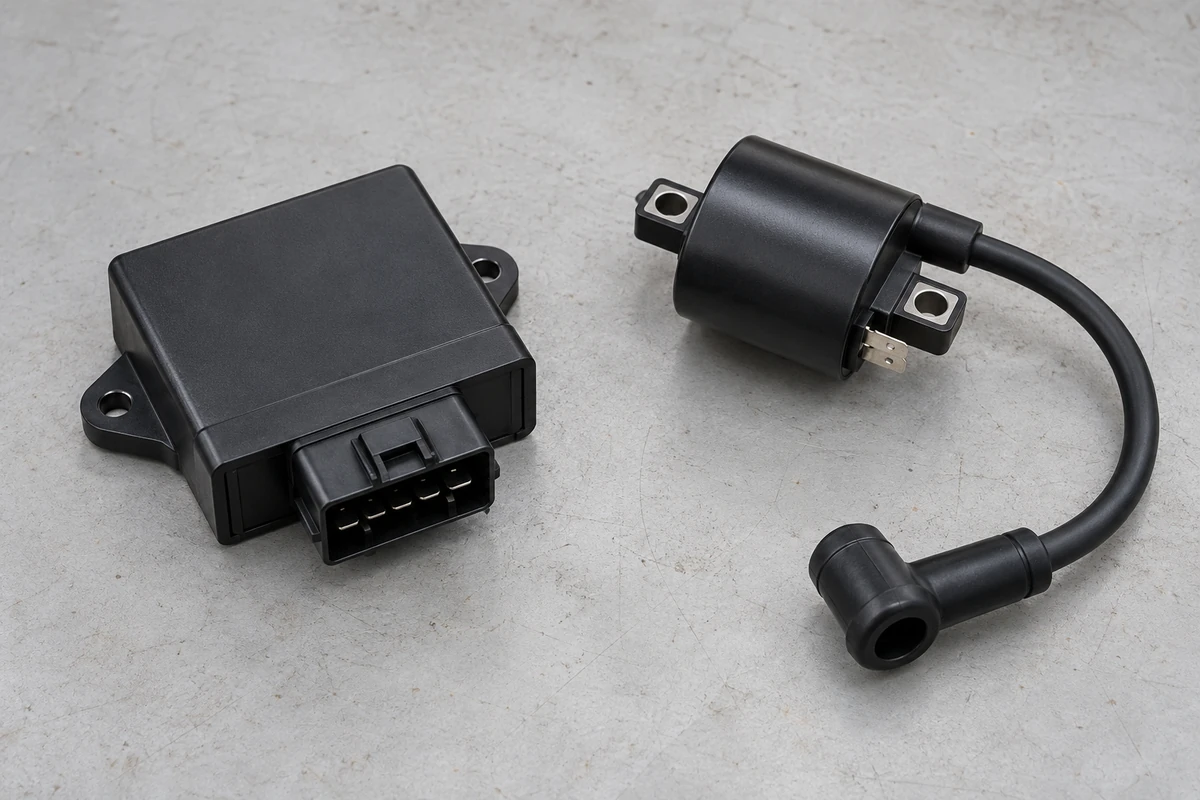
An ignition box offered for the right engine family can still describe the wrong ignition system. An RFQ for an ignition module should name the required architecture and preserve the documented relationship between module, coil and control inputs.
Start beyond the engine stamp. The stamp helps identify the engine, but the buying decision concerns an electrical system. Purchasing should request a documented replacement candidate for the authorized system, without redesigning ignition timing or removing required functions.
Why TCI and CDI need separate records
Shindengen explains TCI through energy stored in the ignition coil before current interruption, while its CDI description uses a charged capacitor discharged to initiate ignition. The CDI description also discusses generator or battery supply paths. These bounded explanations show why the architecture and power-source questions should remain distinct. They do not establish the specifications of an unknown module. Shindengen TCI and CDI overview
Do not collapse the enquiry to 'AC or DC box' or assume a seller uses CDI precisely. Ask for the exact module designation and its application documentation. An architecture answer should identify its source rather than rely on a generic product title.
The supplier's task is to explain what it offers. The vehicle maker or competent technical provider must determine whether that product preserves the actual ignition arrangement. Marketing about starting, high engine speed or enhanced performance cannot replace that assessment.
Preserve the coil and control relationship
Record the coil reference required by the applicable system documentation and ask what evidence supports the offered module with that coil. Do not select another coil simply because the original relationship is unanswered. A changed coil proposal changes the evidence needed for the system.
Keep trigger/control references and required functions separately visible. A reply can identify TCI or CDI correctly yet leave its relationship to the actual trigger and controls unresolved. Ask the responsible provider to name the acceptance evidence for those functions; the buyer should not create a wiring or timing specification from incomplete catalogue descriptions.
Where the installed system differs from the original vehicle record, resolve that history first. An engine swap or previous electrical replacement can make the original model's reference insufficient. Keep what is known and what is assumed in different fields.
A fictional correct label with missing relationships
A fictional buyer has an authorized CDI replacement requirement with a documented coil and control record. Offer A says only 'CDI for this engine' and provides no exact reference. Offer B supplies an exact CDI designation and power-source description but does not identify the supported coil relationship.
A remains unidentified at product level. B has supplied useful information, but the coil/control relationship still needs application-specific evidence. Do not infer it from the fact that both products use the same architecture word. Request the missing record against the exact module, not a brochure about the manufacturer's entire ignition range.
If the supplier instead recommends a module-and-coil package with different functions, keep that as a separate proposal. A larger package is not automatically an answer to the authorized replacement request, and a low package price cannot authorize a functional change.
Keep the RFQ away from tuning instructions
State that the offer must preserve the approved ignition functions and disclose deviations. An independent aftermarket or unbranded candidate can be evaluated on that basis, but the commercial enquiry must not promise original-equipment status, performance gains or engineering acceptance.
Ask for price, quantity and lead time against the exact product after its scope is clear. Leave any missing functional requirement on hold for the technical provider. This article contains no timing-map edits, limiter changes, coil-selection procedure, pinout or installation instructions. Its purpose is to stop an incomplete box description from becoming an unreviewed system decision.
A product-specific quotation worksheet
| Field | Record and request | Keep unresolved |
|---|---|---|
| System architecture | Documented TCI or CDI requirement | Architecture inferred from engine stamp |
| Power source | Applicable system evidence and offered description | AC/DC wording substituted for full identity |
| Coil relationship | Required coil reference and supported module pairing | Another coil chosen to close a paperwork gap |
| Trigger and controls | Actual system references and required functions | Correct architecture assumed to answer all controls |
| Exact module | Maker, full designation and application source | Generic ignition-box title |
| Unresolved functions | Specific missing evidence and responsible provider | Tuning package accepted as ordinary replacement |
Use this original purchasing worksheet to record the supplier’s actual answers. It is not a test procedure or fit certificate; unresolved safety-sensitive application questions require exact product evidence and confirmation by the responsible provider.
Prepare a sourcing request
Use the Motorcycle parts category for the product group and the Motoparts sourcing request for the exact item and unanswered question. Keep any affordable aftermarket or unbranded alternative tied to the authorized application or released drawing. Motoparts is an independent buying agent for aftermarket and unbranded parts; a request does not establish supplier manufacturing capability, guaranteed savings, branded affiliation or technical approval.
The initial form accepts a description of 8–1200 characters and up to five PNG, JPEG, WebP or GIF images, limited to 10 MiB each and 20 MiB total. Authorized drawing images may start a customization enquiry. CAD, PDF and ZIP files require a separately agreed authorized exchange; the image field is not a technical-file portal.
Frequently asked questions
Does an engine code identify the correct ignition module?
It is an identification aid, not a complete ignition-system record. Confirm the exact module architecture, supply arrangement and documented coil/control relationships for the actual vehicle.
Are TCI and CDI interchangeable descriptions?
No. They describe different energy-storage arrangements in the cited manufacturer overview. Ask for precise product evidence rather than assuming a seller uses the labels correctly.
Does a correct CDI label prove the coil is suitable?
No. Preserve the exact module-to-coil relationship in the applicable documentation. A shared architecture label does not establish a particular pairing.
What if an affordable offer changes ignition functions?
Keep it outside the unchanged-replacement comparison and refer the deviation to the responsible technical owner. This RFQ does not authorize tuning, limiter changes or removal of required functions.
Sources
Discuss a sourcing request related to this article.Ignition Module RFQ: Match the System Before Comparing Boxes