
Swing-Arm Kit Pouches: Keep Thrust and Washer Terms
Prevent a simplified washer-pouch label from erasing the approved distinction between thrust elements and ordinary washers in a swing-arm kit.
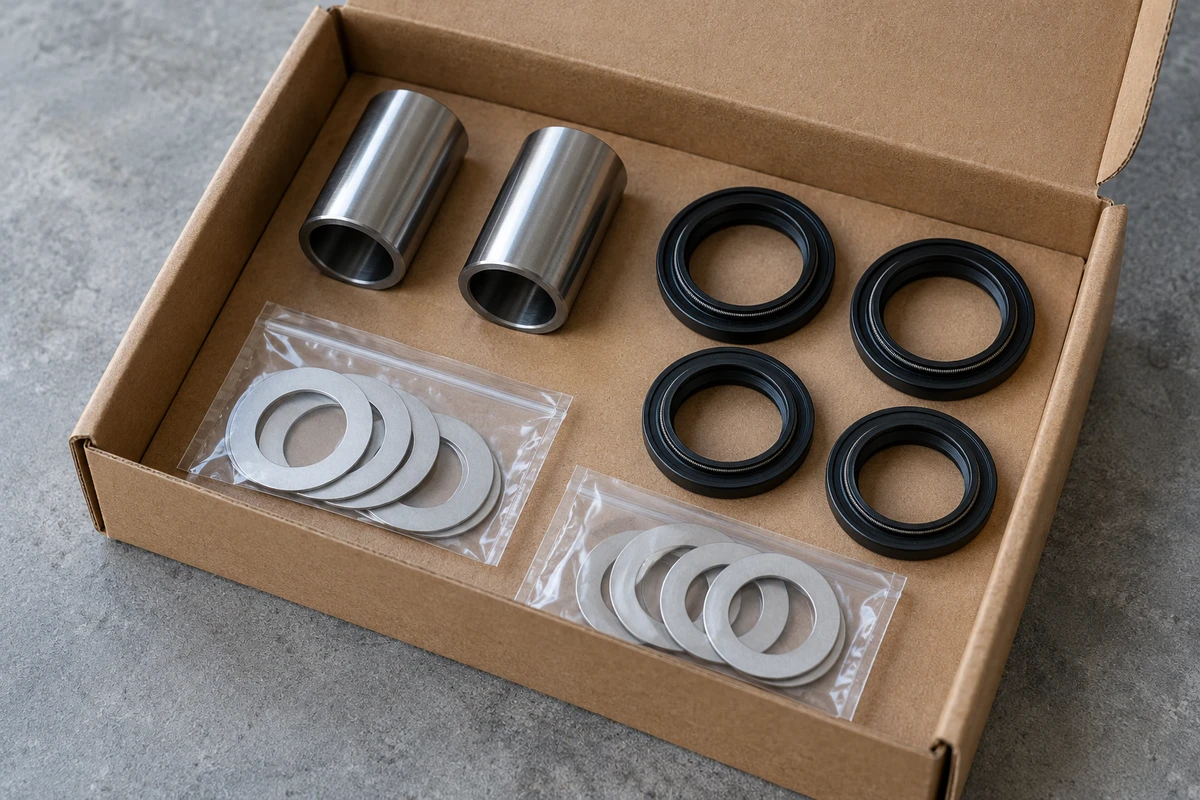
A short pouch label such as 'washers' can erase a distinction that the approved swing-arm kit schedule deliberately retains. Before simplifying the small-parts presentation, ask which provider-defined component names must remain distinguishable in the new pack. Do not let a packing abbreviation become a component substitution.
This decision begins after the kit and its construction are approved. It concerns terminology and the map from those approved terms to supplied pouches. It does not identify a thrust element by appearance, recommend a material change or define an assembly order.
Start with the exact contents table
All Balls Racing's 28-1073 table separately lists thrust bearings and washers alongside bushings, needle bearings, shafts and seals. The named product table was checked on 14 October 2026. It demonstrates separate component terms in that specific kit, not a universal swing-arm bill of materials or a physical pouch layout. All Balls 28-1073 contents
For the actual order, copy the accepted provider terms without replacing them with a broader family name. If the provider calls a component a thrust bearing, preserve that term in the cross-reference. If another accepted kit uses a different construction or terminology, its own record controls; do not impose the example's wording on it.
Keep the provider term separate from a buyer-friendly pouch title. The latter can be short, provided it points unambiguously to the controlled description. A readable label should help the recipient locate the record, rather than ask the recipient to decide which washer-shaped item performs which role.
Ask what the generic pouch conceals
A proposal may combine two already identified groups under one outer pouch while preserving their internal references. Another may remove all subordinate identifiers and call the contents washers. Those changes have different consequences and should not share one approval status.
Ask whether the original component distinction remains available after the first outer layer is removed. If it survives only in a shipping-carton list that will not accompany the kit, the recipient may lose it at handover. Request a provider-supported reference arrangement at the relevant package level.
Avoid treating bag color or position as the sole technical identity. An administrative color cue may support a reference, but it should not assert material, bearing function or installation position. Those meanings belong to the accepted product information.
Fictional example: a shorter label changes the description
Imagine fictional kit S-4 has two separately named entries in its accepted schedule: thrust group T and washer group W. A packaging editor replaces their individual pouch descriptions with 'six washers' because both appear washer-shaped in the artwork. The identifiers and quantities here are fictional.
The new total does not preserve the distinction between T and W. The buyer returns the artwork with the original terms and asks how the proposed pouches map to each. No one needs to identify materials or test a component to explain the documentary error.
Suppose the provider's revision keeps a common outer pouch but preserves separately identified inner groups. That addresses terminology continuity, subject to its actual physical packing review. If it instead proposes replacing T with more W pieces, the matter is a new product change. The packing team cannot approve it by adjusting a label or quantity.
Use a term-to-pouch map
This is an original purchasing worksheet, not a technical standard or an instruction to handle the product.
| Review field | Record or request |
|---|---|
| Exact kit | Accepted kit and contents issue |
| Provider component term | Original terminology retained verbatim where needed |
| Thrust group | Its established source reference, not a visual guess |
| Washer group | Separate approved identity and quantity basis |
| Bag mapping | Pouch reference carrying each controlled distinction |
| Unidentified items | Lost relationships and the responsible provider response |
A term-to-pouch map is intentionally different from an assembly diagram. Do not use numbered bags to imply a fitting sequence unless that sequence is already authorized in the actual product documentation and is within the approved recipient-information scope. This worksheet provides no such sequence.
If loose components are no longer attributable to their source groups, record them as unidentified within the affected supply. A new bag called T does not prove that the contents are the thrust group. Request an attributable provider resolution rather than sorting by shape or choosing the most plausible remaining label.
Approve the wording and mapping together
Review the contents schedule, pouch references and package artwork in one issue. A corrected label without a matching contents map can leave the same ambiguity concealed. A corrected map with obsolete artwork can send the wrong terms to the recipient.
The final handover should retain each provider-defined role and its package reference, including unresolved groups. It closes a naming and allocation question only. It does not approve material equivalence, suspension performance, component condition or installation suitability.
Bring the exact change into the sourcing request
See Dirt bike parts for product context. A Motoparts sourcing request should identify the accepted product, the proposed packing change and the unanswered decision above. Motoparts provides independent aftermarket and unbranded buying coordination and supplier negotiation. Named manufacturers are documentary examples, not branded-supply offers, affiliations or evidence of another provider's capability.
The initial form supports a supported-marketplace HTTPS link, an 8–1200-character description or screenshots. It accepts up to five PNG, JPEG, WebP or GIF images, at most 10 MiB each and 20 MiB combined. PDF, CAD and ZIP files require a separately agreed authorized exchange. The form is not a technical-file portal; a request does not establish engineering approval or a specialist packing service.
Frequently asked questions
Can every washer-shaped piece be called a washer on the pouch?
Use the exact provider-defined terms where they distinguish approved component roles. A generic title may be too broad to preserve thrust-group identity. Appearance is not an authority to rename the component.
Does the All Balls table show how parts are bagged?
No. It lists contents for the named 28-1073 kit. The actual packing provider must identify the pouch arrangement, and other kits require their own accepted contents record.
Can thrust and washer groups share an outer pouch?
The review concerns whether their accepted distinction survives, not a universal ban on shared containers. Obtain a proposal with clear subordinate references and appropriate physical packing support. Do not assume a common label preserves both groups.
What if the groups were mixed before labeling?
Keep the affected items explicitly unallocated and request a provider-supported resolution. Assigning new pouch names or sorting by shape cannot recreate lost component identity. Any proposed substitution needs a separate product decision.
Sources
Discuss a sourcing request related to this article.Swing-Arm Kit Pouches: Keep Thrust and Washer Terms