
Two-Carburetor Kits: Preserve Both Repair Groups
Check that a repacked two-carburetor kit still accounts for both approved repair groups, including any provider-defined shared contents.
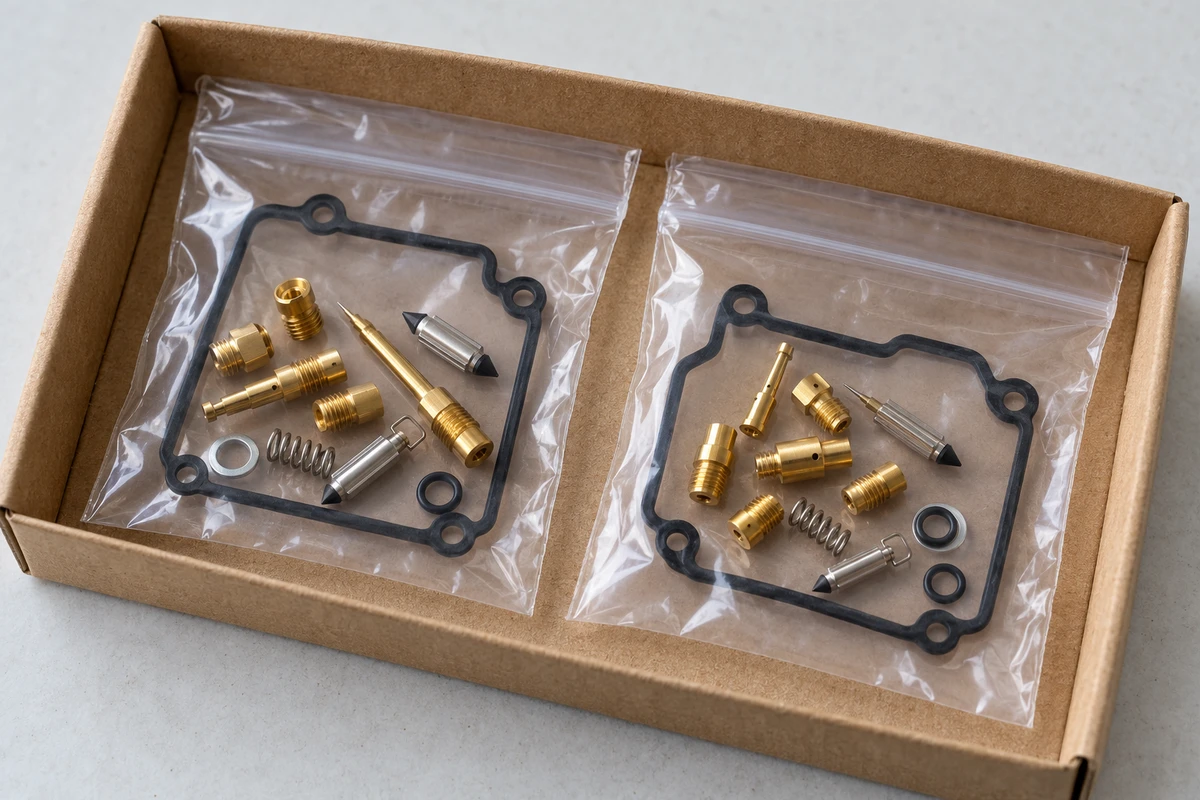
One outer box can represent supply for two carburetors. Repacking that box into a neater tray should not quietly turn its contents into a single-carburetor presentation or an unexplained pile of duplicate parts. Obtain the provider's group map before approving a two-carburetor kit packaging change.
The application and calibration must already be accepted. The buyer's packing question is whether the new arrangement still accounts for the agreed two-unit supply. A complete group map is not evidence that jets suit another market or that left and right components are equivalent.
Confirm what the two-unit statement covers
All Balls Racing's carburetor-rebuild range states that its kits for ATV models with two carburetors include components to repair two carburetors. The same page limits its jet-size basis to US models and cautions about other markets. These statements were checked on 14 October 2026; neither supplies a per-carburetor bill of materials for an unidentified order. All Balls carburetor rebuild kits
Use the exact accepted kit reference and its actual provider contents schedule. Ask which entries belong to each repair group and whether any supplied item is represented at a shared kit level. If the provider has not defined individual group contents, keep that missing map visible instead of inventing equal halves.
The term two-unit scope identifies the purchased coverage, not a direction to split every component quantity by two. Some supplied records may use position-specific references; others may organize parts differently. Preserve the applicable provider terminology and leave technical allocation to its authorized owner.
Compare coverage before counting trays
A proposed layout can contain two pockets yet leave one repair group incomplete. Conversely, one original pouch might contain the provider-defined contents for both groups. The number of physical compartments does not establish the underlying repair coverage.
Request a cross-reference from each supplied group to the proposed pocket or packet. A shared entry should identify what the provider means by shared and where it remains accounted for. Do not count one physical item as separately present in both groups merely because both references point to it.
Ask what recipient action the new presentation implies. If the recipient must divide a bulk group, that is a changed handover requiring explicit agreement and adequate provider information. A packer should not create left/right labels or a sequence that the accepted documentation never supplied.
Fictional example: the second group disappears into extras
Suppose fictional kit D-8 is accepted for a documented two-carburetor application. Its provider record identifies repair groups A and B. A retail mockup puts A in the main tray and calls B 'spare pieces' in a small pouch. These names and facts are invented.
The problem is the changed role of B, not necessarily a missing piece count. The buyer asks the provider to restore the second group's approved identity in the layout and recipient information. Calling components unused in the display does not make them optional in the purchased kit.
Now suppose another mockup gives both groups visible positions but omits a shared entry from the provider's schedule. The first correction did not settle this second gap. Request an explicit home for that entry or a provider explanation of its exclusion. Do not infer that two visibly full pockets equal complete approved supply.
If the actual provider cannot supply a group map, the buyer may retain the originally documented supply arrangement while seeking clarification. This is a scoped proposal to review, not a claim that the original packaging is transport validated or that every unknown can remain unresolved until use.
Build the coverage record
This is an original purchasing worksheet, not a technical standard or an instruction to handle the product.
| Review field | Record or request |
|---|---|
| Kit application | Exact already-approved product and controlling record |
| Approved two-unit scope | Document identifying coverage for both carburetors |
| Provider group map | Actual A/B or other provider-defined relationships |
| Shared versus separate items | Defined quantity basis and unresolved allocation |
| Packed group count | Where each approved group is accounted for |
| Open allocation | Missing map, omitted entry or changed recipient task |
Keep intended grouping and actual packing declarations separate. The layout says where the provider proposes to place the agreed groups; the final declaration says what it reports supplying. Existing package photographs can support identifiable references but do not prove concealed contents or calibration.
Preserve the distinction through later changes
An additional bag, a smaller tray or an omitted pocket should trigger a check of the affected group, not a fresh attempt to choose jets. If a supplier introduces a different kit reference, return that product change to the application owner before adapting the packing map.
Close this review with a named two-group coverage record, any shared entries and the exact recipient arrangement. It should be possible to see where both approved repair groups remain accounted for without treating every repeated component as a spare or every packet as one complete carburetor kit.
Bring the exact change into the sourcing request
See ATV parts for product context. A Motoparts sourcing request should identify the accepted product, the proposed packing change and the unanswered decision above. Motoparts provides independent aftermarket and unbranded buying coordination and supplier negotiation. Named manufacturers are documentary examples, not branded-supply offers, affiliations or evidence of another provider's capability.
The initial form supports a supported-marketplace HTTPS link, an 8–1200-character description or screenshots. It accepts up to five PNG, JPEG, WebP or GIF images, at most 10 MiB each and 20 MiB combined. PDF, CAD and ZIP files require a separately agreed authorized exchange. The form is not a technical-file portal; a request does not establish engineering approval or a specialist packing service.
Frequently asked questions
Does a two-carburetor kit need two identical pouches?
No such layout rule is established here. Obtain the provider-defined contents and group map for the exact kit. The packing arrangement must preserve its approved coverage without assuming equal or interchangeable groups.
Can the second group be labeled as spares?
Not when it is required for the approved two-carburetor supply. Preserve the role given in the provider’s accepted schedule. An item omitted from a display is not thereby optional or a spare.
Does two-unit coverage prove the calibration is correct?
No. The All Balls range separately states its US-model basis. Application, market and component calibration need their own approval; this packing review only accounts for already accepted supply.
How should shared contents appear in the map?
Use the provider’s actual shared-entry description, quantity basis and package location. Avoid representing one physical item twice or assigning a new function. If shared scope is undefined, keep it an open provider question.
Sources
Discuss a sourcing request related to this article.Two-Carburetor Kits: Preserve Both Repair Groups