
Chain Kit Packing: Preserve Each Connecting-Link Packet
Keep an approved chain and its connecting-link packet associated through consolidation, without letting nominal size replace the model record.
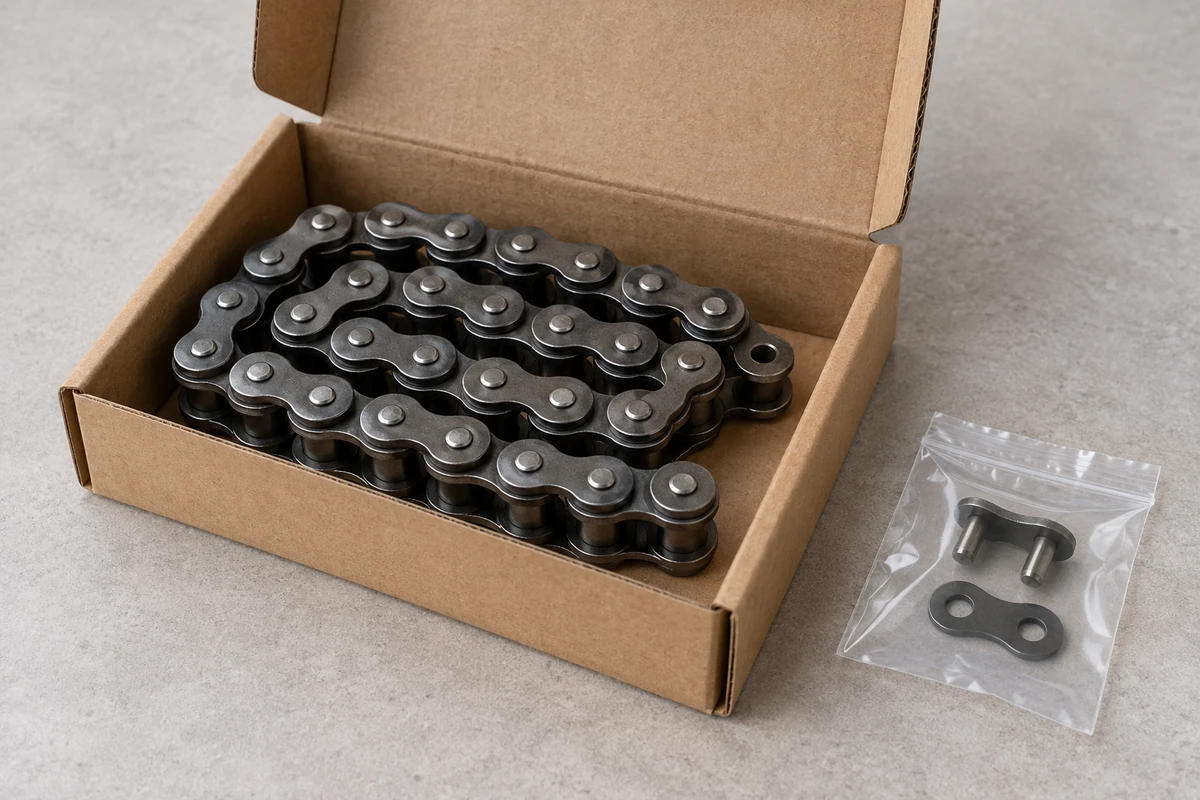
When several approved chain kits enter one consolidated shipment, the smallest packet can become the least traceable part. A chain label may survive on the large package while its connecting link is moved into a common accessories carton. Before approving that move, require a record that follows each supplied packet back to its accepted chain model.
The chain and link combination should already have been approved. This packout decision preserves that established relationship. It does not choose a compatible link, substitute a joining style or instruct anyone to assemble a chain.
Preserve the packet's existing parent
D.I.D's FAQ says connecting links are specific to chain models and cannot be mixed across models. It separately describes different link types. The source gives a reason to preserve a complete model relationship rather than a nominal size alone; it does not establish the contents of an unrelated supplier's kit. D.I.D connecting-link FAQ
Begin with the provider's accepted chain-and-link schedule. Record the full chain reference and the supplied link packet designation together. If the packet has no separate factory identifier, ask the provider which existing record establishes its membership. A buyer's administrative packet number can point to that record, but should not impersonate a manufacturer's serial number.
Retain the packet intact under the applicable supplied-state instructions. The documentary task does not require emptying a packet to display its components. Nor should the packer replace the supplied packet with a common link assortment merely because every chain has the same nominal size.
Find the consolidation step that loses the relationship
Review the proposed handover from individual kit to common carton. Ask when the packet leaves the chain's outer package, what reference remains with it and where the receiving party will find the corresponding chain record. A carton-level list of 'chains and links' cannot answer those packet-level questions.
A proposal that consolidates closed, identified kits creates less documentary change than one that collects all link packets separately. Both still need an appropriate protective arrangement. This article does not establish that either physical packing method is suitable; it asks whether the approved membership remains visible.
If separate packet grouping is genuinely required, request a packet-to-chain schedule before release. Include exceptions such as an additional link bought separately, a packet deferred by the supplier or a packet with an unreadable designation. An extra should not be silently used to complete another kit.
Fictional example: identical size labels, different models
Suppose fictional chain kits C-A and C-B have already accepted model-specific link packets L-A and L-B. The packer proposes a common accessory pouch labeled only with their shared nominal chain size. These are invented identities, not a real D.I.D order.
The proposed label removes the distinction the accepted schedule preserved. The buyer requests a plan that retains the packet-level references and their parent relationships. It is not necessary to determine which link would fit either chain; that was an earlier decision and should not be remade at the packing stage.
Now suppose L-B is missing from the supplier's final schedule. The presence of L-A does not authorize counting one link twice or assigning a spare to C-B. Ask the provider to identify the actual exception and its proposed resolution. If the buyer authorizes a partial dispatch, keep C-B's link status visibly incomplete rather than calling both kits complete.
Use a packet continuity record
This is an original purchasing worksheet, not a technical standard or an instruction to handle the product.
| Review field | Record or request |
|---|---|
| Chain reference | Full accepted chain model and order line |
| Link packet identity | Existing packet reference and provider evidence |
| Approved kit membership | Source establishing the packet-to-chain relationship |
| Consolidation step | Where grouping changes and how references survive |
| Exception packet | Missing, additional or unallocated packet and owner |
| Release record | Final provider declaration and remaining partial supply |
Check the record in both directions: a packet reference should lead to its approved chain, and each approved chain should lead to its accounted-for packet or explicit exception. This is a correspondence check, not a compatibility test. Preserve any difference between intended allocation and the provider's actual dispatch declaration.
If packets have already been mixed without surviving evidence, record the loss of association and ask the responsible provider for a disposition. Reconstructing membership by appearance or by assigning the final packet to the final chain would create evidence that does not exist.
Close the packing question without reopening the repair
A release note can state that the documented packet associations have been preserved for the named consolidation issue. It should not state that the chains are ready to install or that every link has been technically verified. Ring condition, lubrication and installation readiness remain separate questions.
Carry the agreed packet references into any later carton revision. The useful result is a recipient who can locate the supplied link's established chain relationship without guessing from size or a shared carton position.
Bring the exact change into the sourcing request
See Motorcycle parts for product context. A Motoparts sourcing request should identify the accepted product, the proposed packing change and the unanswered decision above. Motoparts provides independent aftermarket and unbranded buying coordination and supplier negotiation. Named manufacturers are documentary examples, not branded-supply offers, affiliations or evidence of another provider's capability.
The initial form supports a supported-marketplace HTTPS link, an 8–1200-character description or screenshots. It accepts up to five PNG, JPEG, WebP or GIF images, at most 10 MiB each and 20 MiB combined. PDF, CAD and ZIP files require a separately agreed authorized exchange. The form is not a technical-file portal; a request does not establish engineering approval or a specialist packing service.
Frequently asked questions
Can link packets for different chain models share an outer carton?
A shared carton does not remove the need for each packet’s established chain-model association. Obtain a provider proposal that preserves the exact packet references and an appropriate protective arrangement. This guide does not approve the physical design.
Is the nominal chain size sufficient on a common link pouch?
It is insufficient to preserve distinct model-specific relationships when those exist in the accepted order. Keep the complete model and packet references from that record. Do not use packing labels to decide link compatibility.
What if the packet has no manufacturer serial number?
Ask which supplier record identifies its original membership. An administrative reference can locate that evidence if clearly described as buyer or packer shorthand. Do not invent a manufacturer identifier or claim that a new label restores lost provenance.
Can an extra link complete a kit with a missing packet?
Only a separately supported and authorized product decision could establish that substitution. For packing, show the missing packet and extra as different entries and obtain the provider’s disposition. Their presence in one shipment does not make them interchangeable.
Sources
Discuss a sourcing request related to this article.Chain Kit Packing: Preserve Each Connecting-Link Packet