
TorqDrive RMS-2813031 Handover: Sleeves and Damper Evidence
Identify which record addresses the retained damper assembly when a sleeve event is used to support a broader clutch-basket closeout.
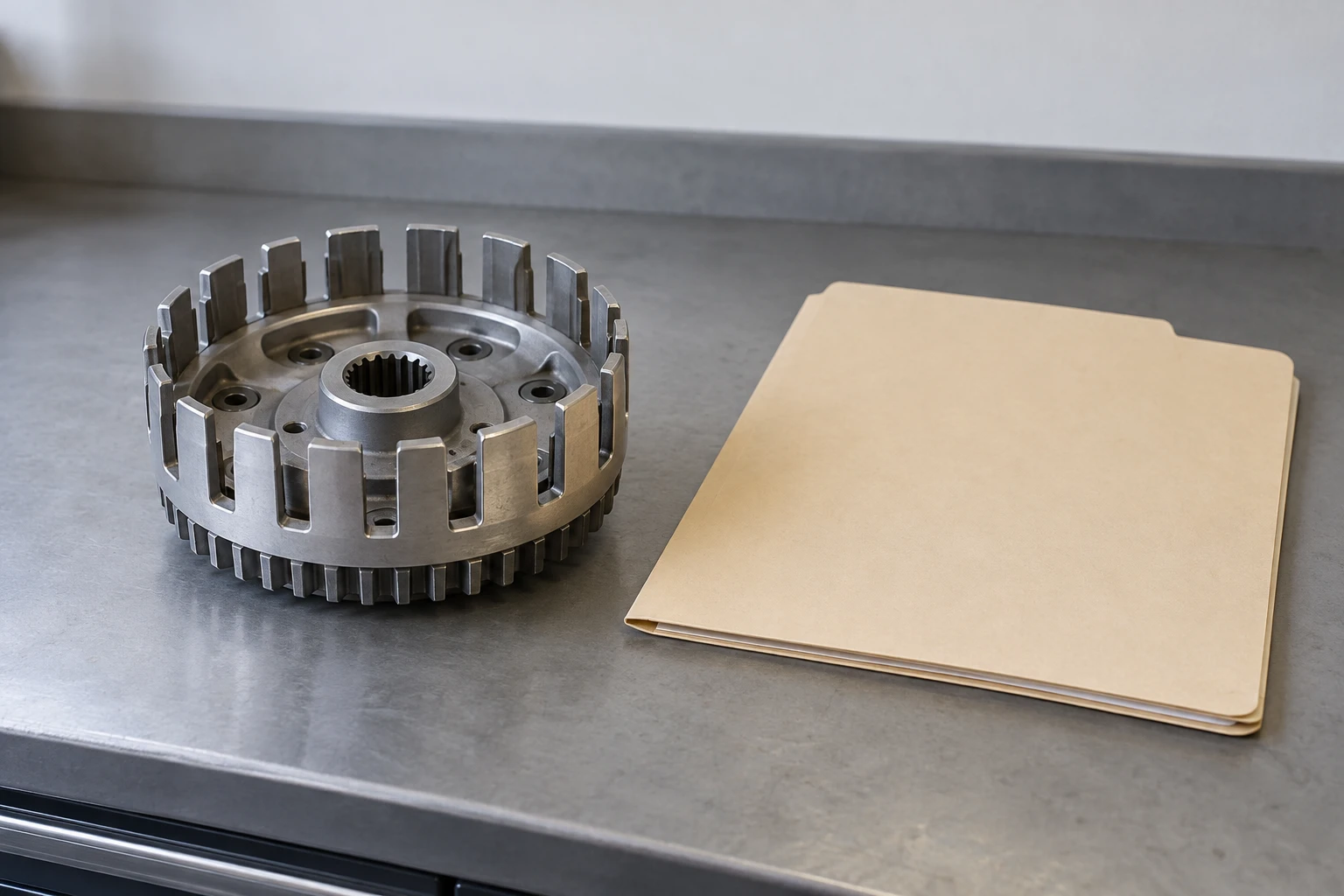
For an already documented Rekluse TorqDrive RMS-2813031 job, a sleeve invoice and a photograph described as showing no basket notching do not answer every question about the retained assembly. If the agreed handover includes damper evidence, ask which record actually addresses that component. First have the responsible provider confirm that the cited sleeve-equipped assembly and its instructions apply to the job.
The purchasing decision is whether the promised evidence has arrived, or whether an additional professional assessment needs a separate proposal. It is not a decision that the dampers are worn, that a basket must be replaced, or that a motorcycle may return to use.
Locate the exact statement being closed
Keep the accepted job scope beside the provider's completion note. A note covering sleeve replacement has a narrower meaning than a declaration about the condition of the complete basket assembly. Preserve the original wording and the identity of its author so that a later clarification can be traced to it.
Ask whether basket and damper assessment formed part of the agreed work. If only a sleeve event was promised, requesting an additional assessment is a new scope question. If a damper record was explicitly promised, locating it is a missing-deliverable question. Neither should be hidden inside a broad request to “finish the paperwork.”
Record the actual kit, basket and non-secret job references from existing documents. Where a component's identity is unknown, leave it unknown. Do not infer the retained design from a generic clutch photograph or assume that every application uses identical rubber dampers.
Why this sleeve example changes the evidence question
The RMS-2813031 product page links a combined guide. Its opening insert, 193-714A revision 030518, distinguishes sleeve protection of friction-contact surfaces from continued wear of retained dampers. It also refers to damper and/or spring constructions. The main manual is separately identified as 191-2813031A revision 121120; this is a product-linked historical document, not a newly issued 2026 instruction. Combined guide, opening insert
That distinction matters when someone uses an account of one surface to support a conclusion about a different retained item. Ask the provider to identify its evidence for the actual damper construction. The buyer's worksheet below does not reproduce the maker's inspection procedure or replace a qualified assessment.
Keep each attachment at its documented scope
A sleeve invoice can identify a supplied item or, if its wording and associated work record establish it, a completed sleeve event. Do not silently promote a parts-sale line into proof of completed installation. Retain the provider's exact description and the associated job reference.
An existing photograph needs the same discipline. Ask what the provider says it depicts, which assembly it belongs to and what conclusion it supports. A useful image can remain useful without being treated as a complete condition report. Receiving staff should not expose, manipulate or test the assembly to fill this documentary gap.
A separate damper assessment, if one exists, needs its own issuer, scope and conclusion. Preserve any stated limits. Its date identifies the event described; it does not create an inspection interval, and a newer sleeve document should not overwrite it. This review establishes no service clock or remaining-life estimate.
Use a short evidence worksheet
This is an original purchasing aid, not a manufacturer form or an acceptance standard.
| Record | Evidence to request | Decision it supports |
|---|---|---|
| Covered assembly | Provider-confirmed kit, basket, job and applicable source issue | Whether this example applies |
| Completion claim | Original wording and attributable issuer | What conclusion needs support |
| Sleeve event | Actual supply or completed-work entry | What happened to the sleeves |
| Retained damper record | Attributable assessment and its stated limits, if available | What is known about that separate item |
| Existing image | Provider explanation of subject and scope | What the image can establish |
| Agreed coverage | Accepted deliverables and exclusions | Missing promised record or additional request |
| Unresolved item | Qualified response and any separately proposed scope | What remains open for the next provider |
Do not combine the sleeve and damper rows merely because one invoice covers the whole visit. If the provider supplies a report covering both, link the relevant parts of that report to each row. One document may contain several valid findings; the point is to preserve which finding concerns which item.
A fictional invoice with a broader cover note
In fictional job C-14, invoice S-14 records a completed sleeve replacement. An existing basket image accompanies a cover note stating that the whole assembly needs no further attention because no notching is visible. No damper assessment is identified. These identifiers and events are invented to illustrate a document discrepancy.
The buyer keeps S-14 as evidence of the declared sleeve event and asks the author to explain the broader conclusion. It requests any existing damper assessment and the agreed scope covering that work. It does not record a defect, demand replacement or presume that further assessment is free.
If an attributable report arrives, the receiving owner can review that report at its actual scope. If the provider confirms the assessment was excluded, the buyer can request a defined proposal and decide whether to authorize it. If the provider cannot establish what happened, the record remains unknown. A new proposal does not prove earlier work was completed.
Transfer a precise record to the next contact
The useful closeout identifies the documented sleeve event, the evidence concerning the retained damper assembly, and any gap between the completion claim and its support. Preserve an explicit qualified disposition rather than replacing it with a purchasing shorthand such as “all checked.”
For product context, see Motorcycle parts. A Motoparts sourcing request can describe the identified component and unanswered supplier question. Our role is independent aftermarket and unbranded buying coordination and supplier negotiation. The manufacturer example establishes no affiliation, branded-goods offer, fit guarantee or specialist-service capability.
Start with a supported marketplace HTTPS link, an 8–1200-character description or screenshots. The form accepts up to five PNG, JPEG, WebP or GIF images, 10 MiB each and 20 MiB combined. PDF, CAD, ZIP and other technical records require a separately agreed authorized exchange.
Frequently asked questions
Does an unnotched TorqDrive basket establish retained damper condition?
For the provider-confirmed RMS-2813031 context, keep the surface evidence separate from the retained damper assessment. The cited insert distinguishes those items. Ask which attributable record supports the damper conclusion; absence of notching alone cannot close that evidence question.
Does replacing sleeves mean that the dampers were also replaced or assessed?
Only the work actually documented should be recorded. A sleeve entry does not identify a damper event merely because both relate to the same basket. Request the separate scope and provider record, or retain that item as unknown.
Does missing damper evidence prove wear or require replacement?
No. Missing evidence describes the record available to the buyer, not the physical condition. Seek the responsible provider’s bounded conclusion and clarify whether further assessment is included or requires a separate proposal. Do not assume a defect, replacement need or free service.
Should receiving staff inspect the assembly to complete the worksheet?
This worksheet authorizes no physical assessment. Use existing records and ask the qualified provider to address their limits. Any additional professional work needs its own applicable scope and authorization; documentary closure is not approval to use the motorcycle.
Sources
Discuss a sourcing request related to this article.TorqDrive RMS-2813031 Handover: Sleeves and Damper Evidence