
Brake Pad Reorders: Keep Street and Closed-Course Demand Distinct
Retain each approved brake-pad reference and use context when calculating the street and closed-course replenishment mix.
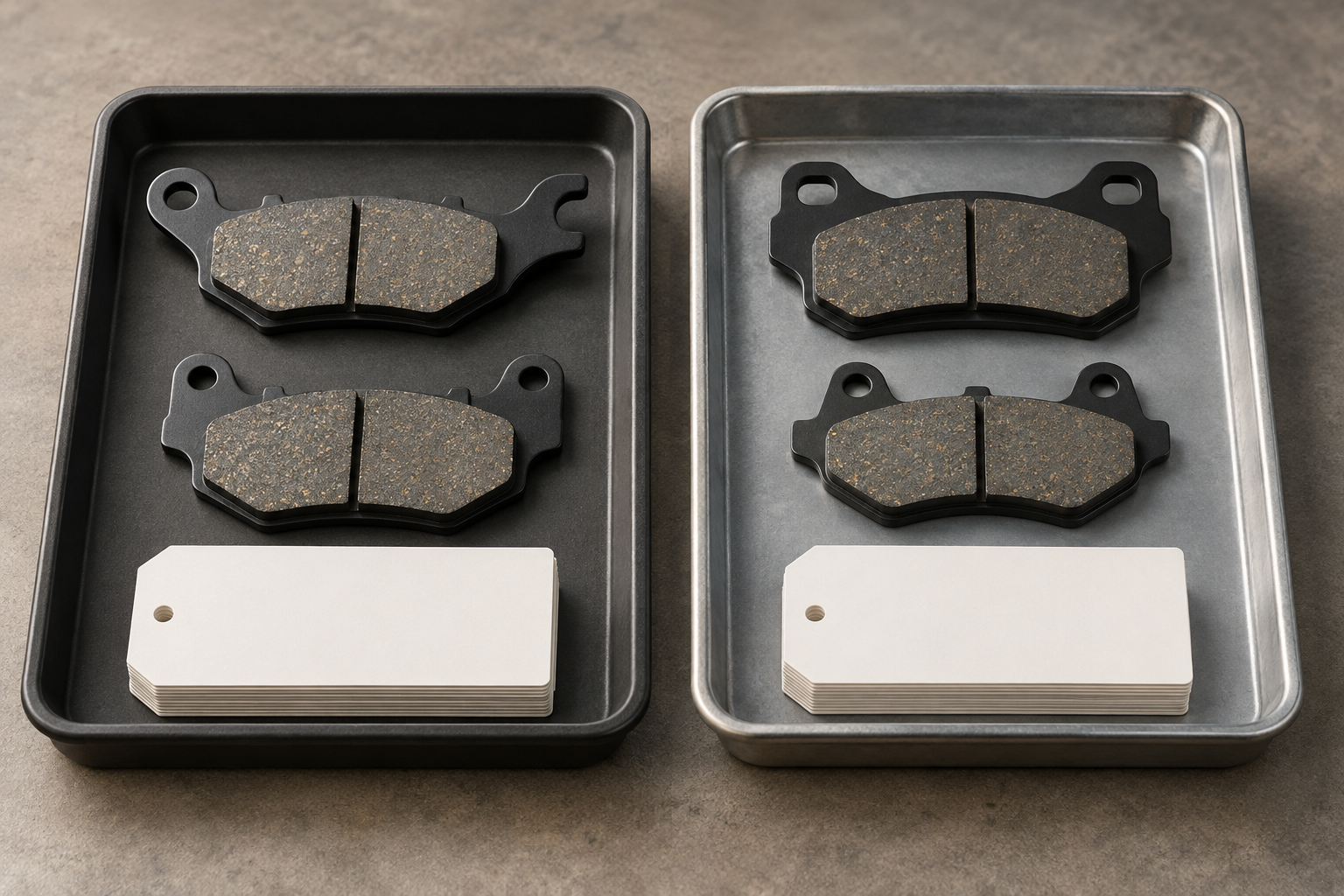
A surplus of one brake-pad family does not automatically cover demand from another use context. A buyer should carry the exact customer-approved pad reference through demand, stock allocation and the next offer, instead of balancing a single total called brake pads.
This article follows existing application and use approvals. It does not recommend compounds, compare braking performance or transfer a product certification to an alternative.
Keep the source’s use descriptions within their scope
EBC's Double-H page distinguishes its streetsport product from named trackday and full-race closed-circuit ranges. The page also describes EPFA in both trackday and street contexts, so street and track wording should not be treated as mutually exclusive universal categories. EBC product-use descriptions
The purchasing key is the actual approved reference and application, with its permitted context recorded. A marketing label such as race, sintered or HH cannot establish equivalence or legal suitability for another product. Keep regulatory or performance questions with the responsible product reviewer.
Reconcile the issue history before choosing a mix
Use exact picked references to interpret historical consumption. A broad brake-pad entry may combine different caliper applications, purchase units and approved contexts. Do not use that combined total to recreate the last order ratio without checking current commitments.
For each current requirement, retain the approved supplied unit. Individual pads, axle descriptions and seller sets must not be mixed as though they were one unit. Ask for the actual offer contents and application basis; this article supplies no universal number of pads per motorcycle or per pack.
Allocate by the accepted choice, not shelf abundance
Apply eligible matching stock to each commitment once. If a customer has explicitly accepted more than one reference, record the actual selection or permitted allocation scope. Do not infer that permission from overlapping manufacturer marketing descriptions or a shared friction label.
A mixed seller case should be expanded into exact references and supplied units. Show the remainder for each line. When the case forces surplus in a context with no current demand, keep that fact visible instead of transferring it to street commitments or inventing future race orders.
Fictional example: the total hides a context gap
Assume five fictional street-context requirements each call for approved set S and three closed-course requirements each call for approved set C. The references are invented, their application decisions are assumed resolved, and no interchange permission is supplied.
Stores has two eligible S sets and six eligible C sets. Despite eight sets on the shelf for eight requirements, only two of the five S requirements are covered. Three S sets remain to purchase, while three C sets remain after the C commitments.
A seller's offer of three more C sets does not answer the S gap. If the actual customer and technical owners later approve a particular alternative for identified S obligations, revise only those lines with the approval source attached. The change is an explicit decision, not a conclusion drawn from inventory surplus.
Reorder worksheet
Use this original purchasing aid with the actual approved records. It does not supply a test, installation method or technical acceptance.
| Field | Record and decision basis |
|---|---|
| Approved pad reference | Exact customer-selected product and application |
| Approved use context | Approved use conditions retained without universalizing labels |
| Committed demand | Unique outstanding requirements in a consistent supplied unit |
| Eligible same-reference stock | Eligible matching sets allocated once |
| Different-use stock | Other-reference stock excluded unless permission exists |
| Current offered mix | Actual case contents, uncovered lines and surplus by reference |
Request the identified replenishment
See Motorcycle parts for category context. In a Motoparts sourcing request, identify the approved product, outstanding quantity and exact supplier question. Motoparts provides independent aftermarket and unbranded buying coordination and supplier negotiation. Named manufacturer examples are documentary references, not branded supply offers, affiliations or evidence of another supplier’s capability.
The initial form supports a supported-marketplace HTTPS link, an 8–1200-character description or screenshots. Image limits are five PNG, JPEG, WebP or GIF files, 10 MiB each and 20 MiB combined. PDF, CAD and ZIP files require a separately agreed authorized exchange. A request supplies no engineering approval, guaranteed saving or delivery commitment.
Frequently asked questions
Can race-labelled surplus cover street orders?
No permission follows from the label or surplus. Use the exact approved reference and applicable customer and technical decisions. The source’s product descriptions do not approve an unknown alternative for road use.
Are street and trackday labels always exclusive?
No. The cited page describes overlap for a named range. Preserve actual product-specific permissions rather than creating a universal two-bin suitability rule from marketing language.
Can equal HH or sintered wording establish equivalence?
No. It does not settle the exact application, use conditions or approval for an alternative. Keep the accepted product reference and unresolved evidence separate from generic friction descriptions.
How should a forced mixed case be evaluated?
Expand its exact references and units, apply them only to supported commitments and show remaining shortages and extras. Compare actual complete terms without inventing future demand for the surplus mix.
Sources
Discuss a sourcing request related to this article.Brake Pad Reorders: Keep Street and Closed-Course Demand Distinct